Axle Load Calculation for Semi-Trailers: A Worked Guide
A truck can be under its gross weight limit and still overload one axle. Treat the trailer as a beam resting on the kingpin and the axle group: the method, a worked example, official limits and practical tips.
· 11 min read
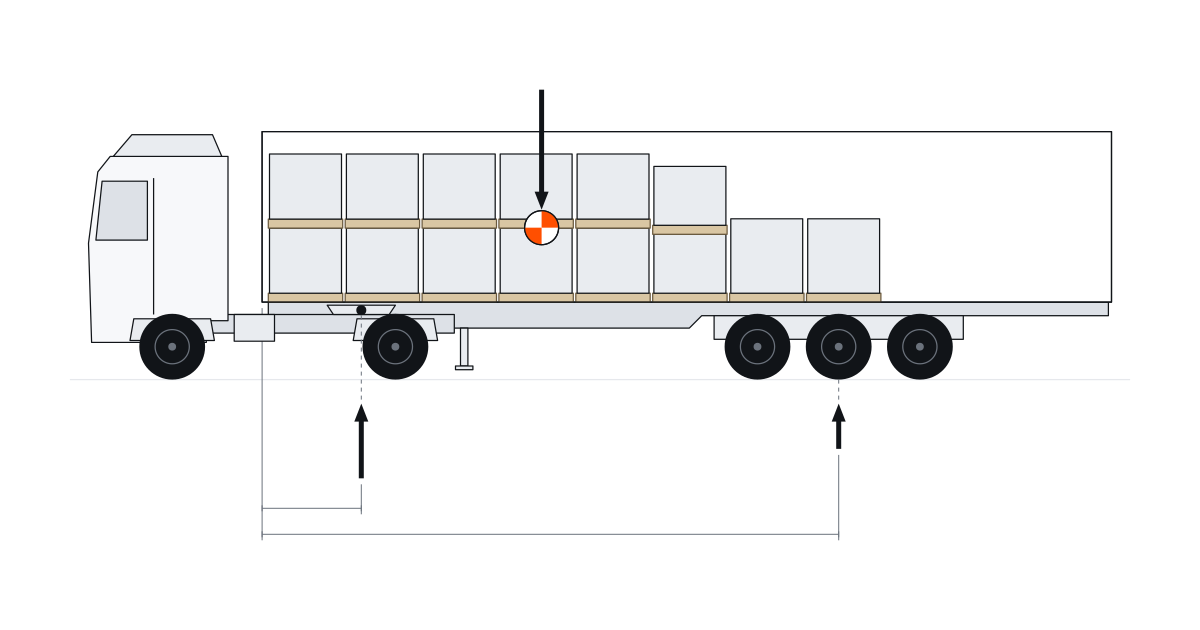
A truck can be under its gross weight limit and still overload a single axle if the cargo sits in the wrong place. Turkey's loading regulation says so in plain terms: vehicles may not be loaded in a way that exceeds the maximum axle weights, even when the maximum laden weight isn't exceeded.
The short answer: you calculate axle loads by treating the trailer as a beam that rests on the kingpin and the axle group. The closer the cargo's centre of gravity is to the axle group, the more the axle group carries; the closer it is to the kingpin, the more lands on the tractor. Below we walk through the calculation step by step, list the official EU and Turkish limits, and show with numbers where a heavy load should sit.
What is axle load and why does it matter?
Axle load is the weight transmitted to the road by the wheels on one axle. Semi trailer axle weight limits exist to protect bridges and pavements; going over them damages the road, upsets braking and handling, and overstresses tyres.
In the EU, Directive 2014/47/EU (2014) on roadside inspections says in Annex III that cargo distribution must take into account both the maximum authorised axle loads and the necessary minimum axle loads. The minimum matters too: if the tractor's driving and steering axles get too light, traction and steering suffer.
The European Commission's 2014 cargo securing guidelines make distributing the cargo with the axle loads in mind one of the loader's tasks, and ask the shipper to state each unit's weight and, if it isn't central, its centre of gravity. Turkey's vehicle loading regulation (2012) goes further and names the consignor alongside the operator when it comes to fines. A badly distributed load isn't only the haulier's problem.
What are the axle weight limits in the EU and Turkey?
EU Directive 96/53/EC (1996, as amended) and Turkey's loading regulation use the same core figures for road freight.
| Axle or vehicle | EU (96/53/EC) | Turkey |
|---|---|---|
| Single non-driving axle | 10 t | 10 t |
| Driving axle | 11.5 t | 11.5 t |
| Trailer / semi-trailer tandem, spacing 1.3–1.8 m | 18 t | 18 t |
| Trailer / semi-trailer tandem, spacing 1.8 m or more | 20 t | 20 t |
| Tri-axle, spacing 1.3 m or less | 21 t | 21 t |
| Tri-axle, spacing over 1.3 m up to 1.4 m | 24 t | 24 t |
| Articulated vehicle, five or more axles | 40 t | 40 t |
| Three-axle tractor with two- or three-axle semi-trailer carrying a 40 ft ISO container | 44 t (intermodal) | 44 t |
This is a summary. The EU adds allowances for alternatively fuelled and zero-emission vehicles, and a revision of the directive is under discussion (procedure 2023/0265(COD)). The limits on a vehicle's registration document can also be lower, and the lower figure applies. Confirm current rules for the countries on your route with your carrier.
How do you calculate axle load?
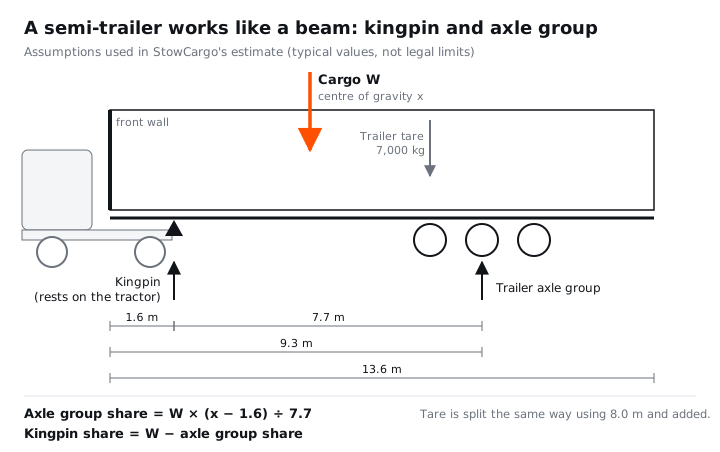
You calculate axle load with a moment balance. Treat the semi-trailer as a beam supported at two points: the kingpin at the front, which sits in the tractor's fifth wheel, and the axle group at the back. The cargo's weight (W) acts at its centre of gravity (x) and is shared between the two supports:
Axle group share = W × (x − kingpin) ÷ (axle group − kingpin)
Kingpin share = W − axle group share
All distances are measured from the front wall. The trailer's own weight (tare) is split the same way from its own centre of gravity, and the results are added. With several items, the combined centre of gravity is the sum of each item's weight times its distance, divided by the total weight.
Worked example: StowCargo's typical trailer model
The figures below are the assumptions StowCargo uses for a curtainsider semi-trailer, not legal limits or the dimensions of any particular trailer: kingpin 1.6 m and axle group 9.3 m from the front wall; trailer tare 7,000 kg with its centre of gravity at 8.0 m; axle group limit used 24,000 kg. The span between kingpin and axle group is 9.3 − 1.6 = 7.7 m.
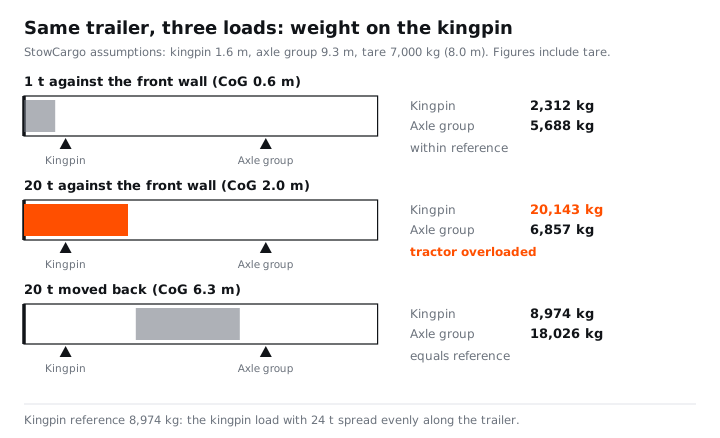
1. Empty trailer (tare): axle group share 7,000 × (8.0 − 1.6) ÷ 7.7 = 7,000 × 6.4 ÷ 7.7 ≈ 5,818 kg; kingpin share 7,000 − 5,818 ≈ 1,182 kg.
2. 24 t spread evenly along the trailer (centre of gravity 6.8 m): the cargo's axle group share is 24,000 × 5.2 ÷ 7.7 ≈ 16,208 kg and its kingpin share ≈ 7,792 kg. Adding tare gives about 22,026 kg on the axle group and 8,974 kg on the kingpin. The axle group stays under the 24,000 kg assumption. StowCargo uses this 8,974 kg as its kingpin reference: the kingpin load the trailer is designed for, with a full payload evenly spread.
3. 1 t against the front wall (two Euro pallets, centre of gravity 0.6 m): the cargo's axle group share is 1,000 × (0.6 − 1.6) ÷ 7.7 ≈ −130 kg. The minus sign means the load sits ahead of the kingpin and slightly unloads the axle group. Kingpin ≈ 1,130 + 1,182 = 2,312 kg; axle group ≈ 5,688 kg. The kingpin is far below the reference, so the load can stay where it is.
4. 20 t of heavy cargo against the front wall (first 4 m, centre of gravity 2.0 m): the cargo's axle group share is 20,000 × 0.4 ÷ 7.7 ≈ 1,039 kg and its kingpin share ≈ 18,961 kg. Adding tare gives about 20,143 kg on the kingpin and 6,857 kg on the axle group, more than twice the reference. For comparison, the legal limits for a tractor's steering axle (single non-driving axle, 10 t) and driving axle (11.5 t) add up to 21.5 t, and the kingpin load alone comes close to that before the tractor's own weight is counted.
Why can a light load stay at the front wall but a heavy one can't?
Loaders start at the cab-side front wall, and for good reason: the headboard then takes the forward braking force, which makes securing easier. With a light load there's no downside. In the 1 t example above, the kingpin carries 2,312 kg, far below the reference. Moving the load to the middle gains nothing for the axles and makes securing harder.
Heavy, dense loads are different. Steel coils, machinery or stone slabs, with a lot of weight in a short length, put almost all their weight on the tractor if they stay at the front wall. The fix is to spread them along the trailer or to move their centre of gravity far enough back.
StowCargo's packing engine applies exactly this rule. By default the load starts against the front wall and the right-hand side wall. If the kingpin load would exceed the kingpin load with a full payload spread evenly, the engine moves the whole load toward the doors only as far as needed. A light load stays put even if its centre of gravity is ahead of the kingpin. Once the load has been moved back, the front gap has to be filled or blocked; our guide to load securing under EN 12195-1 explains why.
How far back does a heavy load need to sit?
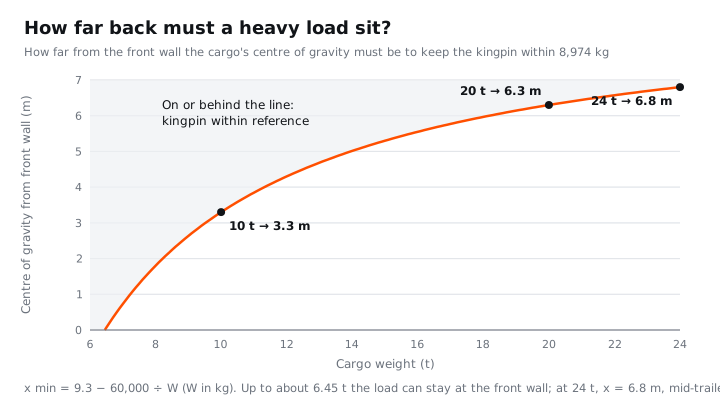
In StowCargo's model, the cargo's centre of gravity has to be at least this far from the front wall to keep the kingpin within the reference:
x min = 9.3 − 60,000 ÷ W (W in kg, x in metres)
The 60,000 is the cargo moment that matches the kingpin reference: 24,000 kg × (9.3 − 6.8) m. A few results:
- Up to about 6,450 kg, the load can't push the kingpin over the reference wherever its centre of gravity is; it can stay at the front wall.
- At 10 t, the centre of gravity must be at least 3.3 m back.
- At 20 t, at least 6.3 m back. For a 4 m long block that means starting 4.3 m from the front wall, which puts about 18,026 kg on the axle group.
- At 24 t, 6.8 m, exactly mid-trailer.
There's a limit in the other direction too. If the centre of gravity moves behind the axle group, the cargo's kingpin share turns negative, the tractor gets lighter and loses traction. StowCargo then tells you to move the load forward. If your own trailer's kingpin and axle positions differ from these assumptions, so do the results; the method stays the same.
How does StowCargo estimate axle loads?
Once the load is placed, StowCargo calculates its centre of gravity from the actual positions of the pieces and shows the split for the vehicle type:
- Semi-trailers (curtainsider, mega, reefer, flatbed): kingpin and axle group loads are estimated including tare. You get a warning if the kingpin exceeds the reference, if the centre of gravity falls behind the axle group, or if the axle group passes its assumed limit.
- Rigid trucks (the 9.6 m rigid truck, 7.5 m rigid, light truck, panel van): front and rear axles are calculated separately. If the front axle is too light, you get a steering warning; if it's overloaded, the app suggests how many metres to move the load toward the doors.
All figures are estimates: geometry and tare are typical values, and the tractor's fifth-wheel position and own axle loads aren't included. Exact numbers come from the vehicle documents and a weighbridge; the estimate's job is to flag a risky layout before loading. For inside dimensions by trailer type, see trailer types and dimensions or the 13.60 m curtainsider trailer page.
Practical tips to keep axle loads within limits
Most axle overloads can be prevented at the planning stage. Before loading:
- Spread heavy items along the trailer. Mix heavy and light lines along the length rather than grouping all the heavy items at one end.
- Keep heavy items low and centred across the width. A high centre of gravity raises the tipping risk, and an off-centre one loads the wheels on one side.
- Plan with real weights. The calculation uses the gross weights on the packing list; missing or guessed weights mean a wrong distribution. Our guide on how to prepare a packing list covers gross weight per line.
- Allow for multi-drop routes. Unloading at the first stop changes the distribution, and what's left still has to be within limits.
- Weigh before you leave. For borderline loads, get an axle-by-axle reading at a weighbridge and compare it with the registration document.
For sea freight, the container's verified gross mass is declared separately; see container VGM under SOLAS.
Conclusion
Axle load calculation is a beam problem: the cargo weight and the position of its centre of gravity decide how it's shared between kingpin and axle group. A light load can safely stay at the front wall; a heavy, dense load overloads the tractor unless its centre of gravity is far enough back. The official limits are largely the same in the EU and Turkey, but the vehicle's own documents always have the final say.
To see how your load sits in a vehicle, start with the free load calculator. For mixed packing lists with centre of gravity, estimated axle loads and a securing suggestion in one report, open a plan in the workspace.