How to Prepare a Packing List: Fields and Example
A packing list shows what is in each package, how many packages ship, and their weights and dimensions. Here is how it differs from the invoice, which fields to include, and a worked net, tare and gross example.
· 11 min read
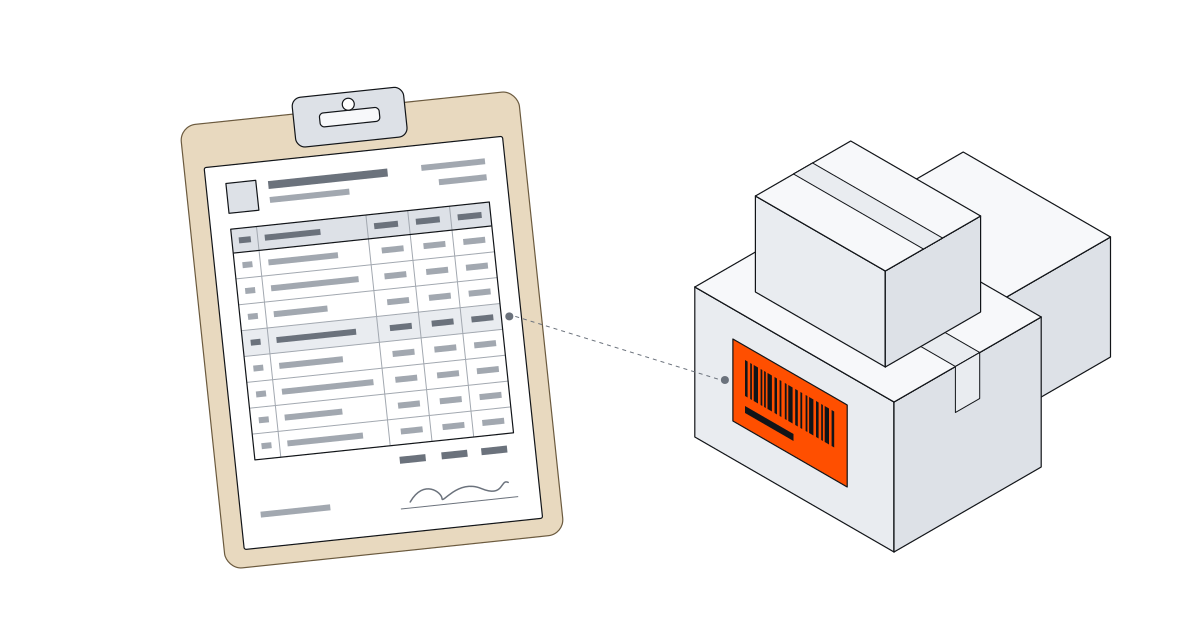
Everyone who touches an export shipment asks the same questions: how many packages are there, what is inside them, how heavy are they and how much space do they take? The packing list answers all of them in one document.
The short answer: a packing list records the contents, count, net and gross weight, dimensions and marks of every package in a shipment. The commercial invoice describes the value of the goods; the packing list describes their physical form. This guide covers the fields to include, the difference between net weight, tare and gross weight (with a worked example), package marks, volume, and why each vehicle should get its own list.
What is a packing list?
A packing list is a document that shows which package each item is in and how much is in each package. The US International Trade Administration's guide to common export documents describes it as listing the seller, buyer, shipper, invoice number, shipment date, mode of transport and carrier, then itemising the packages, their weights and dimensions; customs officials on both sides may use it to check the cargo. The EU's Access2Markets glossary says much the same: the list identifies the contents of the boxes and gives the volume, weight and dimensions of each parcel, and customs may ask for it on export or import.
Turkey's Customs Regulation (Official Gazette, October 7, 2009) defines the packing list in a dedicated article (Art. 117): when goods on one invoice are packed in packages of different kinds and weights, the list shows how much is in each package. The seller or shipper may prepare it with the invoice, or the declarant may prepare it. For goods taxed by weight, it follows the tariff's taxable unit (net or gross weight, count, volume).
Customs is not the only reader: the carrier checks payload and space against it, the warehouse plans loading with it, and the consignee checks arrivals with it. Every number has to match what is actually on the truck.
Packing list vs commercial invoice: what is the difference?
The commercial invoice is the seller's bill to the buyer. The packing list describes how the same goods are packed. The trade.gov guide draws the same line: customs relies on the invoice to determine duties and value, and on the packing list to check the cargo.
| Commercial invoice | Packing list | |
|---|---|---|
| Purpose | Shows the price and terms of the sale | Shows packages, their contents and dimensions |
| Prices and payment | Unit price, total, currency, Incoterms | Usually not shown |
| Weights and dimensions | Usually totals only | Net and gross weight and size per package |
| Packages and marks | Limited | Number and type of packages, marks and numbers |
| Main users | Customs (duty and value), bank, buyer's accounts | Customs (inspection), carrier, warehouse, buyer's receiving dock |
| Shared fields | Invoice no., shipper, consignee, description, quantity | The same fields, spelled the same way |
The most common problem is a mismatch in the shared fields: 192 cartons on the invoice and 190 on the packing list, or a consignee name spelled two ways. Mismatches like these can trigger extra checks at customs. Generating both documents from one source (your ERP or your load plan) removes most of that risk.
What should a packing list include?
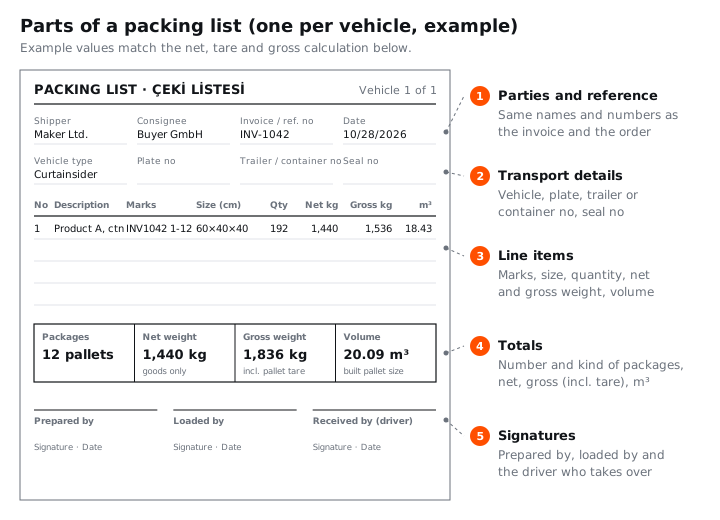
There is no single mandatory template; the content follows from the purpose. Your buyer or your payment terms (for example a letter of credit) may require extra fields, so agree on them with the order. In practice a good packing list has five parts:
- Parties and reference: shipper, consignee (and notify party if any), invoice and order number, date.
- Transport details: mode, vehicle type, plate number, trailer or container number, seal number, place of loading and destination.
- Line items: package number and marks, description, item code, package dimensions, quantity, net and gross weight, volume.
- Totals: number and type of packages (for example "12 pallets"), total quantity, total net and gross weight, total volume.
- Signatures: prepared by, loaded by, and the driver taking over the load.
Packing list example
The example below is a shipment of 192 cartons measuring 600 × 400 × 400 mm, built onto 12 Euro pallets. The StowCargo engine calculated the pallet pattern: 16 cartons per pallet (4 layers of 4), 1,744 mm overall height including the pallet. Each carton holds 7.5 kg of product in 0.5 kg of packaging, and the empty pallet is taken as 25 kg. These are example values.
| Package no. | Marks | Contents | Package size (cm) | Cartons | Net kg | Gross kg | Volume m³ |
|---|---|---|---|---|---|---|---|
| 1 | INV1042-01 | Product A, 16 cartons | 120 × 80 × 174.4 | 16 | 120 | 153 | 1.67 |
| 2–12 | INV1042-02 … 12 | 16 cartons each | 120 × 80 × 174.4 | 176 | 1,320 | 1,683 | 18.42 |
| Total | 12 pallets | 192 | 1,440 | 1,836 | 20.09 |
Net weight vs gross weight vs tare
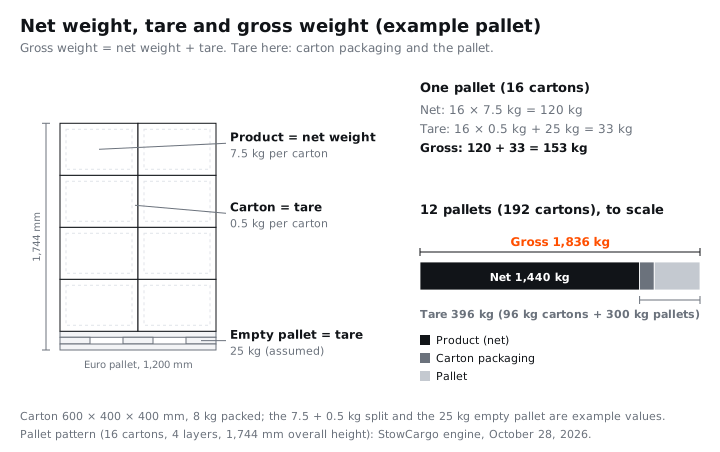
Net weight is the weight of the goods without any packaging. Tare is the weight of the packaging: cartons, stretch film, layer pads, the pallet. Gross weight is the sum: gross = net + tare. The carrier and the vehicle only ever "see" gross weight; payload, axle loads and load securing are all calculated from it.
Here is the example, step by step:
- One carton: 7.5 kg product + 0.5 kg carton = 8 kg packed.
- Net per pallet: 16 × 7.5 kg = 120 kg.
- Tare per pallet: 16 × 0.5 kg cartons + 25 kg pallet = 33 kg.
- Gross per pallet: 120 + 33 = 153 kg.
- 12 pallets: 1,440 kg net + 396 kg tare (96 kg cartons + 300 kg pallets) = 1,836 kg gross.
Whether the pallet counts toward gross weight can depend on the document. Swiss customs, for example, state in their note on customs assessment bases (2013) that reusable pallets are not part of the gross mass in the customs declaration. For the vehicle, the pallet is simply part of the load. A practical rule: keep net, gross including cartons and gross including pallets as separate figures on your packing list, ask your customs broker which one the declaration needs, and ask your carrier which one goes on the transport document. Sea freight adds its own rule for the container's verified gross mass, covered in our VGM and SOLAS guide.
How should packages be marked and numbered?
Package marks are the identity written on each package that ties it to a line on the packing list. Good marks are short and repeated in the same layout on every package:
- The consignee's code or the order number (for example INV1042).
- The package number and the total: "3 / 12".
- The destination.
- Net and gross weight and dimensions, where useful.
- Handling instructions. The standard pictograms ("this way up", "fragile", "keep dry") are defined in ISO 780:2015.
The package number on the box must match the line on the list, so that package 7 can be found from the list alone during an inspection. On pallets, put the number on two faces; a label on one side may be hidden once the pallet is loaded.
How do you calculate dimensions and volume (m³)?
Volume is the product of the outer dimensions in metres: volume (m³) = length × width × height. A 600 × 400 × 400 mm carton is 0.6 × 0.4 × 0.4 = 0.096 m³, so 192 cartons are 18.43 m³.
Build those cartons onto pallets and the answer changes. A built pallet measures 1.2 × 0.8 × 1.744 m on the outside, or 1.674 m³, and 12 pallets come to 20.09 m³. The 1.66 m³ difference is the pallet base plus the space the cartons leave on top of it. Carriers and warehouses handle the load as built, so give total volume using the outer dimensions as shipped and say which basis you used. For carton patterns, see how many boxes fit on a pallet; for pallet footprints, see Euro pallet dimensions.
Why prepare one packing list per vehicle?
When an order is split across several vehicles, one master list is not enough. Each vehicle has its own plate, trailer or container number and seal number, and customs, border posts and the consignee check documents vehicle by vehicle. The CMR Convention also allows a separate consignment note to be required for each vehicle when goods are split; see our CMR consignment note guide.
At scale this gets hard by hand. According to the StowCargo engine, 3,000 cartons of 600 × 400 × 400 mm make 188 pallets at 16 cartons per pallet, and those pallets fill 6 curtainsider trailers in a single layer. You cannot write six correct packing lists without knowing which carton is on which pallet and which pallet is on which truck. A load plan already holds that split, so generating each vehicle's list from the plan is the most reliable approach.

For the internal dimensions and capacity of this vehicle, see the 7.5 m rigid truck page.
Common packing list mistakes
- Quantities or names that don't match the invoice. Generate shared fields from one source.
- Mixing up net and gross. Writing the packed carton weight as "net" is common; net means the goods without packaging.
- Forgetting pallet tare. Even a 25 kg pallet adds 300 kg across 12 pallets.
- Volume calculated from loose cartons. For palletised freight, use the outer size of the built pallet.
- Vague package numbering. Number every package individually and write the same number on the package.
- One list for the whole order. With several vehicles, each needs its own list.
- Last-minute changes not reflected. If a pallet moves to the next truck during loading, both lists must change.
- Unweighed gross weights. Work from weighed figures where you can, not estimates.
How does StowCargo generate a packing list from the load plan?
Once StowCargo has calculated the load plan, it produces a bilingual (Turkish and English) A4 packing list for each vehicle. The list is read from that vehicle's plan, so nothing that isn't on the vehicle can appear on it. It includes:
- Shipper, consignee, reference number, date and vehicle type, plus fields for plate, trailer or container number and seal number.
- Line items with description, item code and order (if used), dimensions, quantity, unit gross weight, net and gross kilograms and volume. Palletised lines are flagged.
- Totals: number and type of packages (for example "12 pallets + 40 pieces"), total quantity, net weight, gross weight including pallet tare, and volume by outer package dimensions.
- Signature fields for the preparer, the loader and the driver taking over.
Net weight appears when you enter a per-item net weight; where you haven't, the list does not guess and says so in a note. The same plan also produces a CMR information sheet, sequence labels and a warehouse loading link the loading team follows step by step on a phone. If you want packing lists to come straight from your ERP, read about ERP load planning integration.
Conclusion
A packing list is the physical twin of the invoice: how many packages, which marks, how much net and gross weight, how much volume. Keep net and gross apart, don't forget pallet tare, state volume as shipped, and give every vehicle its own list. Then customs, the carrier and the consignee all read the same figures.
To see first how many vehicles your shipment needs, try the free load calculator, no account required. To get per-vehicle packing lists together with the plan, start in the workspace.