CMR Consignment Note: What It Is and How to Fill It In
The CMR note records the contract and the condition of the goods on international road journeys. Scope, the three originals, box layouts, reservations and e-CMR, with primary sources.
· 11 min read

Every truck crossing a border in Europe, Turkey or Central Asia carries a CMR note in the cab. It is asked for at the border, at customs and at the consignee's dock, and it is the first document anyone reaches for when a package goes missing.
The short answer: a CMR consignment note is the document that records the contract for an international road haulage job and the condition in which the carrier took over the goods. It is based on the 1956 Geneva Convention on the Contract for the International Carriage of Goods by Road (CMR). Below: when the Convention applies, what the note proves, who signs which copy, how to fill in the boxes, driver reservations and e-CMR, with primary sources.
What is a CMR consignment note?
A CMR consignment note records the contract of carriage between sender, carrier and consignee for an international road journey. The name comes from the French title, Convention relative au contrat de transport international de marchandises par route. The Convention was drawn up under the UN Economic Commission for Europe (UNECE) and signed in Geneva on May 19, 1956. According to the UN Treaty Collection, it entered into force on July 2, 1961 and had 58 parties as of October 2026; Turkey acceded on August 2, 1995, the same day it joined the 1978 Protocol that restated the liability limit in Special Drawing Rights.
It is not a bill of lading. Shippers sometimes call it a "CMR bill of lading" (in Turkish, "CMR konşimento"), but a bill of lading is a sea transport document. Turkey's Customs Regulation makes the same split when it lists transport documents (Art. 118): the bill of lading for sea, the CMR note for road.
When does the CMR Convention apply?
Under Article 1 of the CMR Convention, it applies to every contract for the carriage of goods by road in vehicles for reward where the place of taking over and the place of delivery are in two different countries, at least one of which is a contracting country. The nationality and residence of the parties don't matter.
- A full truckload from Bursa to Munich: the Convention applies.
- A domestic run from Istanbul to Ankara: it does not; national law applies.
- A groupage consignment that changes trucks at a cross-dock: if the contract is international, the CMR framework still applies. For the difference between full and part loads, see FTL vs LTL.
What does a CMR note prove?
Article 4 says the contract is confirmed by the consignment note, but a missing, irregular or lost note does not affect the existence or validity of the contract. The note is still your best evidence. Under Article 9 it is prima facie evidence of the contract, its conditions and the carrier's receipt of the goods. If the carrier entered no specific reservations, the goods and their packaging are presumed to have appeared in good condition when taken over, and the package count and marks are presumed to match the note.
The sender answers for the particulars (Article 7): the sender bears the carrier's costs, loss and damage caused by inaccurate or inadequate entries. Gross weight matters here too. Under Article 23, as amended by the 1978 Protocol, the carrier's compensation for loss is capped at 8.33 units of account (the IMF's Special Drawing Right, SDR) per kilogram of gross weight short. If a pallet weighing 153 kg gross is lost, the cap is 153 × 8.33 = 1,274.49 SDR. For valuable goods, talk to your carrier in advance about the declared value and special interest in delivery that Article 6 lists among the optional particulars.
How many copies are there, and who signs?
The note is made out in three original copies, signed by the sender and the carrier (Article 5). The first copy goes to the sender, the second travels with the goods and is handed to the consignee, and the third stays with the carrier. Once the goods reach the place of delivery, the consignee can require the carrier to hand over the second copy (Article 13).
Printed sets often have more copies. The IRU's guide to the 2007 model CMR note describes four colours: red for the sender, blue for the consignee (travelling with the goods), green for the carrier and black for administrative procedures. All copies must be filled in identically.
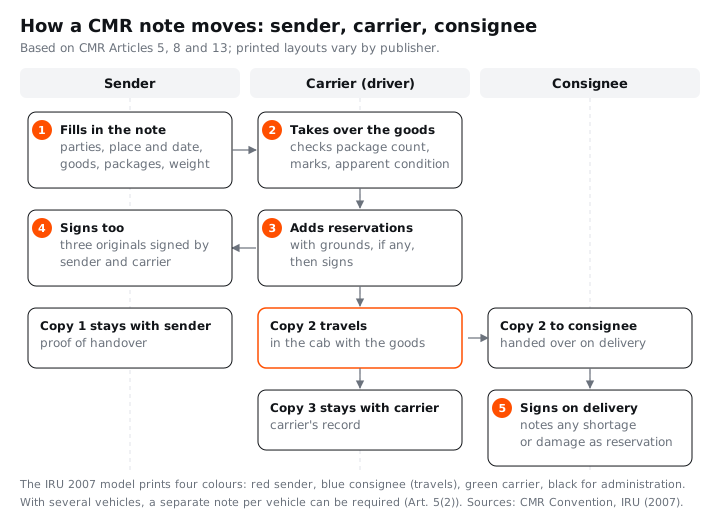
When goods are split across several vehicles, the sender or the carrier may require a separate note for each vehicle (Article 5(2)). That is a strong reason to prepare packing lists per vehicle too; see how to prepare a packing list.
How do you fill in a CMR note, box by box?
Article 6 lists what the note must contain: the date and place it is made out; the names and addresses of sender, carrier and consignee; the place and date of taking over and the place of delivery; the ordinary description of the goods and the method of packing (and the generally recognised description for dangerous goods); the number of packages and their marks and numbers; the gross weight or other quantity; the charges; instructions for customs and other formalities; and a statement that the carriage is subject to the Convention notwithstanding any clause to the contrary. Where relevant it also covers a ban on trans-shipment, charges the sender pays, cash on delivery, declared value, insurance instructions, the agreed time limit and the list of documents handed to the carrier.
The Convention gives no box numbers; the numbering belongs to whoever prints the form. Two layouts are common today: the classic 24-box layout, as in the sample form on Poland's official education platform, and the IRU 2007 model. The same information sits in different boxes:
| Field group | Classic layout | IRU 2007 |
|---|---|---|
| Sender, consignee | 1, 2 | 1, 2 |
| Place of delivery; place and date of taking over | 3, 4 | 4, 3 |
| Documents attached | 5 | 9 |
| Goods (marks, packages, packing, nature, gross kg, m³) | 6–12 | 10–15 |
| Sender's instructions | 13 | 5 |
| Payment and cash on delivery | 14, 15, 20 | 17, 19 |
| Carrier and successive carriers | 16, 17 | 6, 7 |
| Carrier's reservations and observations | 18 | 8 |
| Special agreements | 19 | 16 |
| Place and date of issue; signatures | 21–24 | 21–24 |
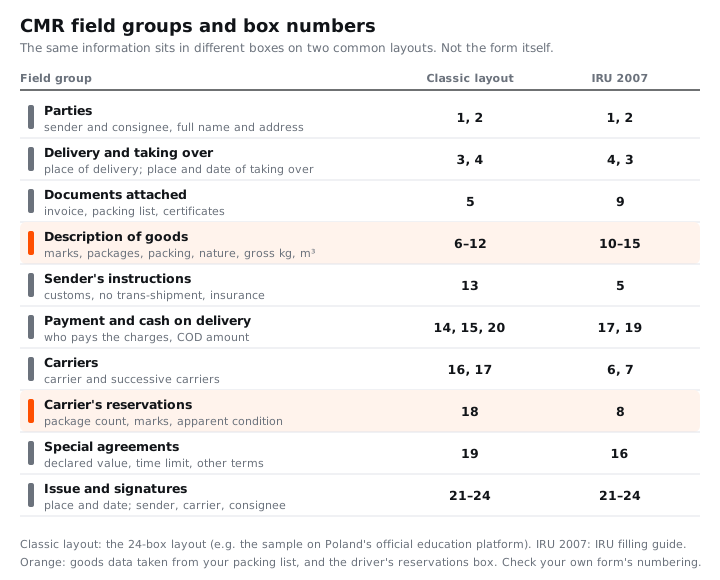
On the classic layout, the goods boxes for the 12-pallet example from our packing list guide read:
- 6, marks and numbers: the marks on the packages, e.g. "INV1042-01 … 12".
- 7, number of packages: 12.
- 8, method of packing: "12 Euro pallets, stretch-wrapped".
- 9, nature of the goods: the same wording as the invoice.
- 10, statistical number: the tariff code, if required.
- 11, gross weight (kg): 1,836.
- 12, volume (m³): 20.09.
These figures come from the packing list's total line; invoice, packing list and CMR must agree.
What do driver reservations mean?
On taking over the goods, the carrier checks the package count, marks and numbers against the note and the apparent condition of the goods and packaging (Article 8). If the count can't reasonably be verified, or the packaging looks wrong, the carrier enters reservations with the grounds for them. On the classic layout that's box 18; on the IRU 2007 model, box 8.
Reservations don't bind the sender unless the sender expressly agreed to them on the note, and with no reservations the goods are presumed taken over in good order and in the stated number (Article 9(2)). So count the load with the driver and leave nothing to reserve about. A note such as "not counted" or "not present at loading" weakens your position in any shortage dispute. For who is responsible for securing the load and how, see load securing under EN 12195-1.
The consignee has deadlines too (Article 30): apparent loss or damage must be reserved at the latest on delivery, non-apparent loss or damage in writing within 7 days of delivery (Sundays and public holidays excepted). Compensation for delay requires a written reservation reaching the carrier within 21 days of the goods being placed at the consignee's disposal.
What is e-CMR, and who uses it?
e-CMR rests on the Additional Protocol that allows the consignment note to be issued electronically. According to the UN Treaty Collection, the Protocol was adopted in Geneva on February 20, 2008, entered into force on June 5, 2011 and had 42 parties as of October 2026; Turkey acceded on January 31, 2018.
Being a party doesn't mean every trip can run on e-CMR: the countries on the route, the carrier and the consignee all need to accept it. Paper CMR remains valid. If you're considering e-CMR, ask your carrier which platform they use and whether it is accepted on your route.
Common CMR mistakes
- Package count or gross weight that doesn't match the packing list. Take the figures from the packing list's total line.
- Pallet tare left out of gross weight. The carrier and the truck carry the pallets too.
- One CMR for several trucks. Each vehicle's load and paperwork should be separate.
- Vague description of goods. Use the invoice wording rather than "general cargo"; for dangerous goods, use the generally recognised description.
- Writing in the wrong box. Check the layout you're using; classic and IRU 2007 differ.
- Copies filled in differently. Information added to one copy later and missing from the others invites disputes.
- Missing date, time and signature on delivery. The IRU guide recommends recording arrival and departure times, which helps in waiting-time disputes.
- Signing without reading the reservations. Read every note the driver has written before you sign.
What does the StowCargo CMR information sheet provide?
StowCargo does not issue the official CMR form; you and your carrier fill in the printed or electronic note. What StowCargo produces from the load plan is a CMR information sheet for each vehicle, in Turkish and English, with the cargo data you need to fill in the form:
- Fields for sender, consignee, place of delivery, place and date of taking over, carrier, plate and trailer.
- The content of boxes 6–12 on the classic layout: marks and numbers (the plan reference), number of packages, method of packing (e.g. "12 pallets + 40 pieces"), nature of the goods, a blank for the statistical number, gross weight including pallet tare, and volume by outer package dimensions.
- Per-drop packages, gross weight and volume when the vehicle has several delivery points.
The figures match the packing list from the same plan, because both are calculated from the vehicle's actual layout. For the internal dimensions and capacity of a 13.6 m curtainsider, see the curtainsider trailer page, and for other trailer types, trailer types and dimensions.

On loading day, the warehouse team can follow the same plan step by step on a phone and attach a photo of the loaded vehicle; see warehouse loading.
Conclusion
The CMR note is the signed answer to four questions on every international road job: what, how many packages, how heavy, in what condition. Know when the Convention applies, take package count and gross weight from the packing list, issue a separate note per vehicle, check which box layout your form uses, and read the driver's reservations before signing.
To see how many vehicles your shipment needs, try the free load calculator, no account required. To get per-vehicle packing lists and CMR information sheets with the plan, start in the workspace.