FTL vs LTL: When Does a Full Truckload Pay Off?
With a full truckload you pay for the whole trailer; with a part load you pay for the space you take. How part loads are priced and how to find the point where a full truck wins.
· 12 min read
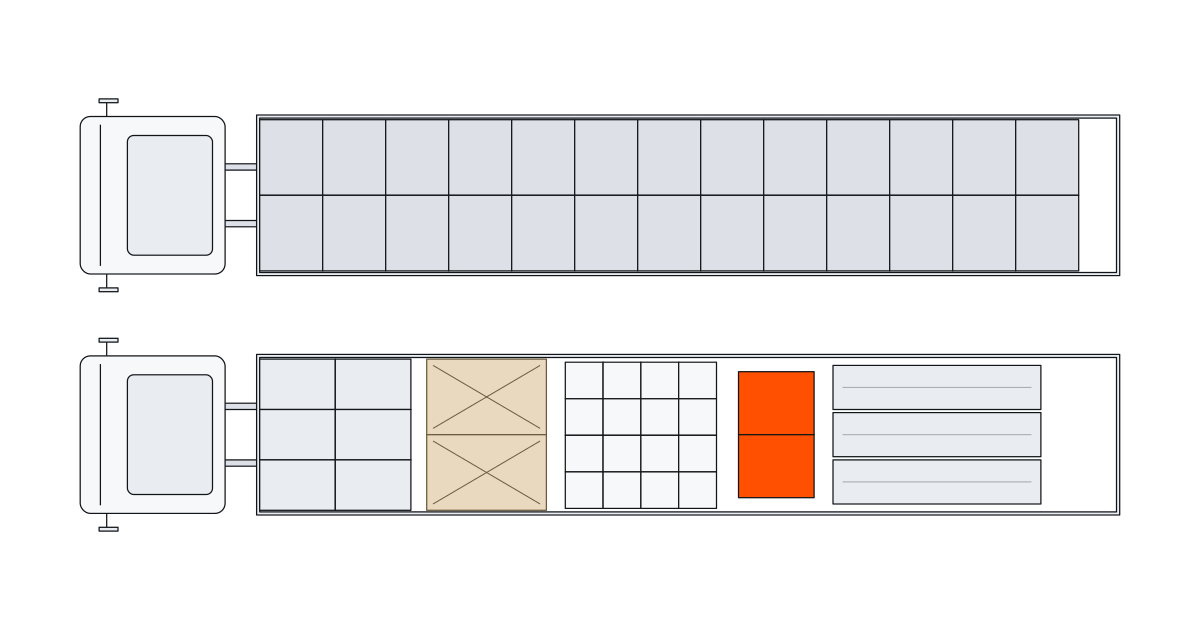
Every road shipment comes down to one choice: book the whole truck (full truckload, FTL) or share it with other shippers and pay only for the space you use (less than truckload, LTL, also called part load or groupage). A full truck is priced per vehicle; a part load is priced on its loading metres (LDM), weight or volume.
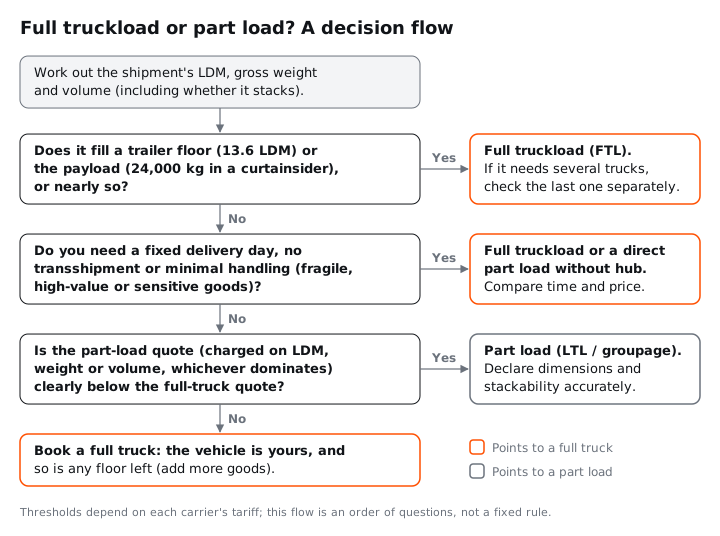
The short answer: small shipments usually travel cheaper as part loads, while shipments that fill most of a trailer's floor or payload are usually cheaper as a full truckload. The exact tipping point depends on each carrier's rates, so no one can give you a universal number. What you can know precisely is how much of a trailer your goods take up, and that is what makes the comparison fair. This guide covers the definitions, how part loads are priced in Europe and Turkey, when a full truck wins, and how load planning supports the decision.
What is a full truckload (FTL)?
A full truckload is a shipment that gets the whole vehicle to itself. The truck is loaded at your site and drives straight to the consignee. It doesn't stop to pick up other shippers' freight and doesn't pass through a cross-dock.
FTL is priced per vehicle for a given lane and trailer type. Whether you fill half the floor or all of it, you usually pay the same rate. The upside is that any floor left over is yours: you can add more of your own goods at no extra freight cost. In European and Turkish road freight the standard FTL vehicle is the 13.60 m curtainsider, typically 13,600 × 2,480 × 2,700 mm inside with a 24,000 kg payload. See the 13.60 m curtainsider page for details, and the guide to trailer types and dimensions for mega, reefer and flatbed trailers.
What is less than truckload (LTL)?
Less than truckload is road freight in which several shippers share one vehicle and each pays only for the space its goods occupy. In Europe it's more often called a part load or groupage. Anything from a single pallet to around half a trailer can travel this way.
Part loads are often collected into a hub, consolidated with other freight, linehauled once the trailer is full and then split again at a destination hub for delivery. As a result, the goods are handled more often than on a full truck, and transit time depends on how quickly the trailer fills and on the network's departure schedule.
Is groupage the same as LTL?
In everyday use, mostly yes. There is a nuance, though. Groupage usually refers to scheduled networks where freight is consolidated and cross-docked at hubs. Many carriers also offer direct part loads: you share the truck with a few other shippers, but your goods stay on board from pickup to delivery with no hub in between. When requesting quotes, ask which one you're getting, because transit time and damage risk depend on it.
One note for readers in North America: US and Canadian LTL is typically priced through freight classification and density rather than loading metres. This guide focuses on European and Turkish road freight, where LDM is the norm.
FTL vs LTL: what are the key differences?
The core difference is what you pay for; transit time, handling and flexibility follow from that.
| Factor | Full truckload (FTL) | Part load (LTL, groupage) |
|---|---|---|
| Pricing unit | Per vehicle, by lane | Whichever dominates: LDM, weight or volume |
| Use of the vehicle | The whole truck is yours | Only the space you occupy |
| Route | Direct from pickup to delivery | Often via collection and delivery hubs |
| Handling | At loading and unloading | Possible extra handling at hubs |
| Transit time | Fixed once the truck departs | Depends on consolidation and schedules |
| Best for | Large, heavy, high-value or sensitive freight | A few pallets, stackable, standard packaging |
| Accuracy of declarations | Less critical: the truck is yours | Critical: dimensions and stackability change the price |
The last row is easy to overlook. On a part load, the carrier measures your freight at pickup. If the declared dimensions or stackability don't hold up, the invoice is recalculated. On a full truck that risk disappears, but you still need to be sure the load actually fits.
How are part loads priced?
Carriers look at a part load three ways: loading metres, gross weight and volume. They convert each into a common chargeable unit using their own tariff and bill whichever comes out highest. In other words, your price follows the dominant characteristic of the shipment.
- Loading metres (LDM): the length of a 2.40 m wide trailer your goods occupy, LDM = length (m) × width (m) ÷ 2.4. A Euro pallet is 0.4 LDM and an industrial pallet 0.5 LDM. Non-stackable pallets are usually charged on LDM. The full method and examples are in our loading metre (LDM) guide.
- Gross weight: the weight of goods, packaging and pallet. Dense freight such as metal parts, ceramics or stone is usually charged on weight.
- Volume: cubic metres from the outer dimensions. It can dominate for light, bulky goods such as textiles, foam or furniture.
How many kilograms one LDM or one cubic metre counts as varies by carrier and sometimes by lane; there is no industry-wide factor. Before you put two quotes side by side, ask each carrier which conversion factor they use, whether there is a minimum charge, whether partial rows are rounded up, and whether collection and delivery are included.
When does a full truckload become cheaper than LTL?
A full truck becomes cheaper once the total of the part-load quote approaches or exceeds the full-truck rate. If a part-load carrier charges P per loading metre and a full truck costs F, the break-even point is roughly F ÷ P loading metres: above that, FTL wins. For freight charged on weight or volume, run the same calculation in that unit.
Because that ratio changes with the carrier, season and lane, we won't give you a fixed threshold. What is fixed is how much of the trailer your shipment takes, and that is half of the decision:
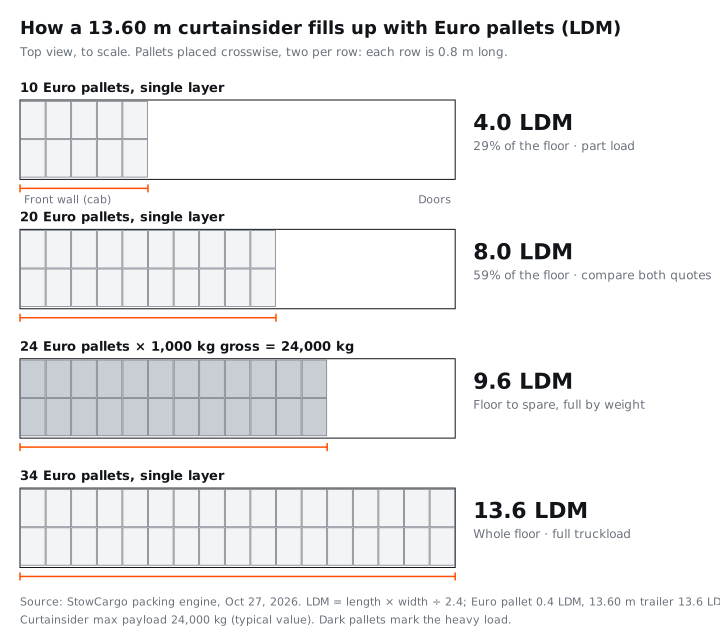
| Euro pallets (single layer) | LDM | Share of a 13.6 LDM floor |
|---|---|---|
| 10 | 4.0 | 29% |
| 17 | 6.8 | 50% |
| 20 | 8.0 | 59% |
| 24 | 9.6 | 71% |
| 34 | 13.6 | 100% |
When your goods take a small share of the floor, LTL is almost always the better deal. As the share grows, request both quotes. Two details often swing the answer.
Stacking halves the floor space
Pallets that can be stacked two high take half the floor. Twenty Euro pallets are 8.0 LDM in one layer and 4.0 LDM stacked, so 29% of the trailer instead of 59%. The same shipment can land on either side of the FTL threshold depending on the stackability declaration. The condition is that two loaded pallets fit under the internal height (2,700 mm in a curtainsider) and that the bottom packaging can carry the top load. How you build cartons onto pallets decides that height; see how many boxes fit on a pallet.
Weight fills the truck before the floor does
Heavy freight maxes out a truck long before the floor is covered. Twenty-four Euro pallets at 1,000 kg gross each take 9.6 LDM, or 71% of the floor, yet their 24,000 kg equals a curtainsider's typical payload. Even if a carrier accepts it as a part load, nothing else can go on that truck and the price will follow the weight, so a full-truck quote usually makes more sense. Legal gross weights are set in law: in the EU, for example, a two-axle tractor with a three-axle semi-trailer is limited to 40 tonnes in international traffic (Council Directive 96/53/EC, EUR-Lex). For heavy loads, check how the weight is spread over the axles, not just the total; our axle load calculation guide explains how.
How should you plan the last truck of a multi-truck order?
When an order needs several trucks, the last one is often only partly full, and that's where most of the savings are. Take 3,000 cartons of 600 × 400 × 400 mm at 8 kg each. With an 1,800 mm height limit, 16 cartons fit on a Euro pallet, which gives 188 pallets; our packing engine places them in a single layer across 6 curtainsiders.
The first five trucks are full with 34 pallets each (170 pallets). That leaves 18 pallets for the sixth: 18 × 0.4 = 7.2 LDM, a little over half the floor. You now have three options:
- Book the sixth truck as an FTL and use the spare 6.4 LDM for goods from your next order,
- Send the remaining 18 pallets as a part load,
- Move them to a smaller vehicle: a 7.5 m rigid truck (7,500 × 2,450 × 2,600 mm inside) takes exactly 18 Euro pallets in one layer.

Quotes still decide which option is cheapest, but the load plan makes sure you're asking the right question. Requesting prices on total cubic metres alone, without knowing how many trucks you need or how full the last one is, leads either to booking a truck too many or to freight that doesn't fit at pickup. For pallet and carton counts per vehicle, see how many pallets fit in a truck.
Which is safer for transit time and damage?
On a full truck, your goods stay on the vehicle they were loaded on until they're unloaded at the destination. On a part load, especially hub-based groupage, they may be unloaded and reloaded along the way. Every extra handling step adds risk of damage or loss and adds time. If the price difference is small, a full truck or a direct part load is the safer choice for:
- Fragile, crush-sensitive or high-value goods,
- Time-critical shipments, such as deliveries that feed a production line,
- Pallets with non-standard sizes, or pallets that must not be stacked or have anything placed on them.
On a part load, your pallets share a truck with other people's freight, and there's no guarantee the securing will be planned around your goods. Wrapping each pallet into a stable unit with stretch film, corner boards and strapping where needed, labelling it clearly and marking it as non-stackable all reduce risk. On a full truck you can plan the securing around your own load; see load securing under EN 12195-1.
How does load planning support the FTL vs LTL decision?
Every input to the FTL vs LTL decision comes out of the load plan: how many vehicles you need, how many loading metres the last one takes, total weight and volume, and whether stacking actually works. Guessing is easy for one pallet type, but much harder with mixed carton sizes, several pallet types and non-stackable lines in the same order.
StowCargo takes your packing list and places the load in the vehicle you choose, in your browser, in seconds. You see the number of vehicles, the load length in LDM for each, volume utilization, gross weight and estimated axle loads together. When a carrier asks how many loading metres, how heavy and whether it stacks, you answer with the plan itself rather than an estimate. For a full truck, the same plan becomes step-by-step loading instructions for the warehouse and a loading report.
Conclusion
Choosing between FTL and LTL is a price comparison, but a good comparison starts with accurate numbers. Know how many loading metres, kilograms and cubic metres your shipment takes, whether it really stacks, and how it splits across vehicles; then compare the total part-load price with the full-truck rate. Remember that heavy freight fills a truck before the floor does, and that the last truck of a large order is a decision of its own.
To see how many vehicles and loading metres your pallets or cartons need, try the free load calculator. No account required.