How Many Pallets Fit in a Truck? Trailer Capacity Table
A 13.6 m curtainsider trailer takes 34 Euro or 26 industrial pallets in one layer. Here are the counts for eight road vehicles and how stacking and weight change them.
· 11 min read

A standard 13.6 m curtainsider trailer holds 34 Euro pallets (1,200 × 800 mm) or 26 industrial pallets (1,200 × 1,000 mm) in a single layer. Those figures come from our packing engine, run on October 27, 2026 against a typical internal size of 13,600 × 2,480 × 2,700 mm, and they assume zero gap between pallets. In practice, many shippers and carriers plan 33 Euro pallets instead. This guide explains why, gives the counts for other European road vehicles, and shows how stacking height and payload change the answer.
It covers European-standard equipment. North American 53 ft trailers and 48 × 40 in pallets follow different math. For internal dimensions of every vehicle and container, see the vehicle and container dimensions guide.
How many Euro pallets fit in a 13.6 m trailer?
34 fit in one layer, but only in one pattern and only with no clearance at all. A Euro pallet measures 1,200 × 800 mm, the size standardized in EN 13698-1. On a trailer floor 2,480 mm wide, you can lay it out two ways.
Two abreast, crosswise: 34 pallets
The 1,200 mm side runs across the trailer. Two pallets side by side take 2,400 mm, leaving 80 mm in total at the walls. Each row uses 800 mm of length: 13,600 ÷ 800 = 17 rows, and 17 × 2 = 34 pallets. Nothing is left at the doors.

Three abreast, lengthwise: 33 pallets
Now the 800 mm side runs across. Three pallets side by side again take 2,400 mm, but each row uses 1,200 mm of length. Eleven rows fit in 13,600 mm (13,200 mm used), so 11 × 3 = 33 pallets, with 400 mm left over.
That 400 mm is why 33 is so common on booking forms. The 34-pallet pattern has no tolerance: if the internal length is a few centimeters short, something at the front wall or door frame intrudes, or cartons overhang a pallet edge, the last pallet won't go in. Many planners also give up one row for forklift handling and securing equipment, so agree in writing with your carrier which figure the quote assumes.
Industrial pallets are simpler. The 1,200 mm side runs across, two abreast, and each row takes 1,000 mm. Thirteen rows use 13,000 mm, giving 26 pallets and a 600 mm gap that can't take another row. Full specs and drawings are on the 13.6 m curtainsider trailer page.
How many pallets fit in each type of truck?
The table below shows single-layer pallet capacity for eight road vehicles common in Turkish and European freight. All counts come from the same engine run (October 27, 2026; one layer, no gaps). The LDM columns convert the pallets that fit into loading meters: a Euro pallet is 0.4 LDM and an industrial pallet is 0.5 LDM.
| Vehicle | Internal L × W × H (mm) | Euro pallets | Euro LDM | Industrial pallets | Industrial LDM |
|---|---|---|---|---|---|
| Curtainsider trailer 13.6 m | 13,600 × 2,480 × 2,700 | 34 | 13.6 | 26 | 13.0 |
| Mega trailer | 13,600 × 2,480 × 3,000 | 34 | 13.6 | 26 | 13.0 |
| Reefer trailer | 13,300 × 2,460 × 2,600 | 33 | 13.2 | 26 | 13.0 |
| Flatbed trailer | 13,600 × 2,480 × 2,650 | 34 | 13.6 | 26 | 13.0 |
| Rigid truck 9.6 m | 9,600 × 2,450 × 2,700 | 24 | 9.6 | 18 | 9.0 |
| Rigid truck 7.5 m | 7,500 × 2,450 × 2,600 | 18 | 7.2 | 14 | 7.0 |
| Light truck | 4,300 × 2,100 × 2,200 | 8 | 3.2 | 6 | 3.0 |
| Panel van (long) | 3,500 × 1,750 × 1,800 | 5 | 2.0 | 3 | 1.5 |
Internal dimensions are typical values and differ by a few centimeters between manufacturers. If your load sits right at the limit, recalculate with the actual vehicle you've booked.
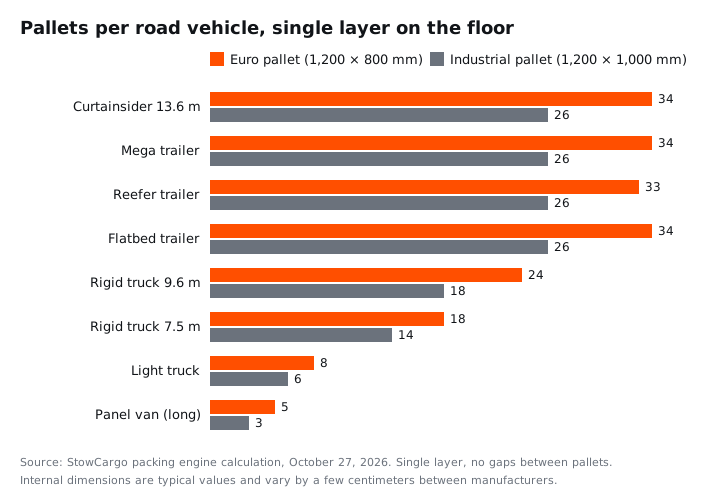
Two practical points stand out. First, the reefer trailer's insulated walls make it 300 mm shorter and 20 mm narrower than a curtainsider, so 33 Euro pallets is its true maximum, not a safety margin. Second, mixing orientations matters in narrow vehicles. In a light truck 2,100 mm wide, pallets all facing the same way top out at 6. Put one lane crosswise (1,200 mm) and the next lengthwise (800 mm), and the width used is 2,000 mm, which gets you 5 + 3 = 8 pallets.
Shipping containers hold fewer pallets per meter because their internal width is about 2,352 mm, and two Euro pallets crosswise (2 × 1,200 = 2,400 mm) don't fit. See our shipping container dimensions and pallet capacity guide for those numbers.
How does stacking change the pallet count?
If the goods can be stacked, the count can double, and internal height sets the limit. For two layers, each layer, including the pallet itself, has to stay under half the internal height. Leave a few centimeters on top as well, so a forklift can lift the upper pallet into place.
| Vehicle | Internal height | Max per layer (2 layers) | Euro pallets, 1 layer | Euro pallets, 2 layers (max) |
|---|---|---|---|---|
| Curtainsider trailer 13.6 m | 2,700 mm | 1,350 mm | 34 | 68 |
| Mega trailer | 3,000 mm | 1,500 mm | 34 | 68 |
| Reefer trailer | 2,600 mm | 1,300 mm | 33 | 66 |
| Rigid truck 9.6 m | 2,700 mm | 1,350 mm | 24 | 48 |
This is where a mega trailer earns its place. It has the same floor as a curtainsider, so it takes the same number of pallets in one layer. The extra 300 mm of height only pays off when you stack or ship bulky cartons. In the same engine run, a curtainsider took 884 cartons of 600 × 400 × 400 mm (93.2% of its volume) and a mega trailer took 1,020 (96.8%): 136 more cartons from height alone. Dimensions are on the mega trailer page.
Check three more things before you stack. The lower load must be able to carry the upper pallet, which usually comes down to carton strength. The upper pallet needs full support from the load below. And a second layer pushes you toward the weight limit quickly, as the next section shows. For groupage (LTL) freight, stacking also changes the loading meters you pay for; our guide to loading meters (LDM) covers how.
Does weight or space run out first?
Light goods fill the floor first; heavy goods hit the payload first. To find the tipping point, divide the vehicle's payload by the number of pallets that fit. For a 13.6 m curtainsider, 24,000 kg ÷ 34 = 705.9 kg. If your Euro pallets average more than that, you'll reach maximum payload before the floor is full. For industrial pallets, the threshold is 24,000 ÷ 26 = 923.1 kg.
| Vehicle | Max payload | Average per Euro pallet | Average per industrial pallet |
|---|---|---|---|
| Curtainsider trailer 13.6 m | 24,000 kg | 705.9 kg | 923.1 kg |
| Mega trailer | 24,000 kg | 705.9 kg | 923.1 kg |
| Reefer trailer | 22,000 kg | 666.7 kg | 846.2 kg |
| Flatbed trailer | 25,000 kg | 735.3 kg | 961.5 kg |
| Rigid truck 9.6 m | 18,000 kg | 750.0 kg | 1,000.0 kg |
| Rigid truck 7.5 m | 15,000 kg | 833.3 kg | 1,071.4 kg |
| Light truck | 3,500 kg | 437.5 kg | 583.3 kg |
| Panel van (long) | 1,300 kg | 260.0 kg | 433.3 kg |
These payloads are typical values from the engine's vehicle data. The real figure depends on the tractor unit, the trailer and its registration, so use the number your carrier confirms.
Stacking halves the threshold. With 68 Euro pallets double-stacked in a curtainsider, the average can't exceed 24,000 ÷ 68 = 352.9 kg. Even below the total limit, distribution along the trailer matters: if the heavy pallets all end up at the front or the back, one axle group can be overloaded. That check doesn't change how many pallets you load, but it does change where they go.
How do you load mixed pallet sizes on one trailer?
Count row by row. Euro and industrial pallets share the 1,200 mm side. Load both two abreast with that side across the trailer, and each industrial row takes 1,000 mm while each Euro row takes 800 mm.
For example, 10 industrial pallets take 5 rows, or 5,000 mm. The remaining 8,600 mm holds 10 Euro rows (8,000 mm), which is 20 Euro pallets. That's 30 pallets in total with 600 mm left at the doors. This is the simplest row calculation; a packing engine will also try other orientation combinations.
The classic mistake is adding up loading meters and comparing the total with 13.6. Take 27 industrial pallets: 27 × 0.5 = 13.5 LDM, comfortably under 13.6. Yet only 26 fit on the floor, because the last row needs 1,000 mm and only 600 mm remain. LDM is useful for freight pricing, but geometry decides whether the load fits. And avoid stacking pallets with different footprints: an upper pallet that overhangs the one below loses support.
What are the most common pallet-count mistakes?
Most of them come from assuming the numbers on paper match the vehicle at the dock.
- Planning on the nominal length. "13.6 m" is a vehicle class. The internal length may be a few centimeters shorter, and since the 34-pallet pattern has no tolerance, that alone can leave a pallet behind.
- Ignoring overhang. Cartons that overhang the pallet enlarge its footprint. If a 1,200 × 800 mm pallet grows to 1,220 × 820 mm with 10 mm of overhang on each side, only 13,600 ÷ 820 = 16 rows fit crosswise: 32 pallets, not 34.
- Stacking without checking height. Two 1,400 mm pallets won't fit under a 2,700 mm roof. Finding that out at the loading dock means the truck leaves half empty.
- Thinking about weight last. If your average pallet weight is above the threshold, plan around payload rather than floor positions.
- Trusting the LDM total. As the 27 industrial pallet example shows, the sum can fit while the pallets don't.
- Forgetting the unloading sequence. With multiple drops, pallets for the first stop need to sit near the doors, and that doesn't always allow the tightest pattern.
How can you check the count for your own load?
The tables cover standard pallets and typical dimensions. For your own shipment:
- Measure the real footprint of the loaded pallet, overhang included, and its height.
- Compare the average pallet weight with payload divided by pallet count.
- Ask the carrier for the actual internal dimensions and payload of the vehicle.
- Enter your numbers in the free load calculator. It needs no account and works for one product and one vehicle type at a time. It shows how many units fit, or how many vehicles a given quantity needs, along with volume utilization and load length. Add a unit weight and it respects the payload too.
- If you ship several products, multiple drops or need axle load checks, move to a full planning tool. Our guide to load planning software explains what such a tool should do, and the StowCargo plans and pricing page lists what the workspace covers.
A plan only works if the warehouse follows it. If the crew loads pallets in a different order, the calculated count won't hold. The warehouse loading page shows how step-by-step loading works on a phone.
Conclusion
A 13.6 m trailer takes 34 Euro or 26 industrial pallets in one layer, and 33 Euro pallets is the safer plan when you need clearance. Stacking can double the count, but always check height and payload together. To see the real number for your own pallet size and weight, try the free load calculator.