Loading Metre (LDM): What It Is and How to Calculate It
LDM = length × width ÷ 2.4. A Euro pallet is 0.4 LDM, an industrial pallet 0.5 LDM and a 13.60 m trailer 13.6 LDM. The formula, worked examples, a trailer table and the mistakes that change your freight bill.
· 11 min read
If you ship part loads by road in Europe or Turkey, the carrier will almost always ask one question before quoting: how many loading metres is it? The loading metre (LDM) is the length of a standard 2.40 m wide trailer that your goods take up, and it is one of the main units European road carriers use to price part-load (LTL) and groupage freight.
The short answer: LDM = length (m) × width (m) ÷ 2.4. A Euro pallet is 0.4 LDM, an industrial pallet is 0.5 LDM and a 13.60 m trailer is 13.6 LDM. Below you'll find worked examples, a table by pallet type and vehicle, how stacking changes the number, and the mistakes that most often change a freight bill after pickup.
What is a loading metre (LDM)?
A loading metre is the length of trailer floor your shipment occupies, measured in metres, assuming the full usable width is 2.40 m. One LDM is therefore a strip 2.40 m wide and 1 m long, which equals 2.4 m² of floor.
The idea behind it is simple. A carrier sells trailer length. If your goods occupy the first 4 metres of the trailer, no other customer's freight can go there, even if your pallets are light. Weight and volume alone don't capture that lost space; LDM does.
You'll see LDM mostly in road freight for part loads and groupage. On a full truckload (FTL) you hire the whole trailer anyway, and ocean freight is usually priced per container. For the internal size and LDM of each road vehicle, see the truck and container dimensions guide.
How do you calculate loading metres?
Convert the footprint of the load to metres, multiply length by width, and divide by 2.4:
LDM = length (m) × width (m) ÷ 2.4
For several pieces, work out the LDM of each and add them up. If pieces can be stacked, count only the ones standing on the floor: a pallet on top doesn't take any new floor space.
Worked examples
| Shipment | Calculation | LDM |
|---|---|---|
| 1 Euro pallet (1.2 × 0.8 m) | 1.2 × 0.8 ÷ 2.4 | 0.4 |
| 10 Euro pallets, non-stackable | 10 × 0.4 | 4.0 |
| 10 Euro pallets, stacked two high | 5 stacks × 0.4 | 2.0 |
| 1 industrial pallet (1.2 × 1.0 m) | 1.2 × 1.0 ÷ 2.4 | 0.5 |
| 6 industrial pallets, non-stackable | 6 × 0.5 | 3.0 |
| Crate without pallet (3.0 × 1.2 m) | 3.0 × 1.2 ÷ 2.4 | 1.5 |
| Full-width load (5.0 × 2.4 m) | 5.0 × 2.4 ÷ 2.4 | 5.0 |
The last row shows the shortcut: when a load spans the full trailer width, its LDM is simply its length. Euro pallets work out the same way. Three pallets placed lengthwise side by side (3 × 0.8 m = 2.4 m) take 1.2 m of length, so each pallet is 0.4 LDM. Two pallets placed crosswise (2 × 1.2 m = 2.4 m) take 0.8 m, which again gives 0.4 LDM per pallet.
How many LDM per pallet type and per vehicle?
A Euro pallet is 0.4 LDM and an industrial pallet is 0.5 LDM. A 13.60 m trailer is 13.6 LDM and takes 34 Euro pallets or 26 industrial pallets in a single layer. The table below shows the same figures for common road vehicles. Pallet counts come from our packing engine (single layer, no gap between pallets); in practice you may plan one row less to leave room for the forklift and load securing. Internal dimensions are typical values and vary by a few centimetres between manufacturers.
| Vehicle | Internal length | Floor (LDM) | Euro pallets | Euro LDM | Industrial pallets | Industrial LDM |
|---|---|---|---|---|---|---|
| Curtainsider trailer 13.60 | 13,600 mm | 13.6 | 34 | 13.6 | 26 | 13.0 |
| Mega trailer | 13,600 mm | 13.6 | 34 | 13.6 | 26 | 13.0 |
| Flatbed trailer | 13,600 mm | 13.6 | 34 | 13.6 | 26 | 13.0 |
| Reefer trailer | 13,300 mm | 13.3 | 33 | 13.2 | 26 | 13.0 |
| Rigid truck 9.6 m | 9,600 mm | 9.6 | 24 | 9.6 | 18 | 9.0 |
| Rigid truck 7.5 m | 7,500 mm | 7.5 | 18 | 7.2 | 14 | 7.0 |
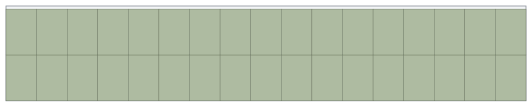
The industrial pallet column deserves a closer look. By the area formula, 26 industrial pallets are 13.0 LDM, yet they use up the whole 13.60 m trailer. Placed crosswise two per row (2 × 1.2 m = 2.4 m), each row takes 1.0 m of length, and the 0.6 m left after 13 rows is too short for another row. On a full load, the real floor share of an industrial pallet is therefore a little more than 0.5 LDM. It rarely matters for a part load, but keep that leftover in mind when you check whether a shipment fits one trailer. Full specs are on the 13.60 m curtainsider trailer page.
On vans and light trucks narrower than 2.40 m inside, LDM is only a pricing unit: the vehicle's width decides how many pallets actually fit. For pallet and carton counts per vehicle, read how many pallets fit in a truck, and for sea freight, shipping container dimensions and pallet capacity.
Why do carriers charge by LDM, weight or volume?
Carriers look at a part load three ways: actual weight, volume and loading metres. They typically convert each into a common chargeable unit using their own tariff and bill whichever comes out highest. In other words, your price follows the dominant characteristic of the shipment.
- Heavy, compact freight (metal parts, ceramics): takes little floor but uses up the vehicle's payload quickly. Weight usually sets the price.
- Light, bulky freight (textiles, foam, furniture): low weight, but height and volume fill the trailer. Volume may set the price.
- Non-stackable pallets: nothing can go on top, so the space between the pallet and the roof is lost. LDM usually sets the price.
How many kilograms or cubic metres one LDM counts as varies by carrier and sometimes by lane; there is no single factor everyone uses. When you compare quotes, ask each carrier which conversion factor they apply, whether there is a minimum charge, and whether they round partial rows up. The gap between two quotes for the same shipment often comes down to those three answers.
There's also a tipping point. As a part load grows, booking a full truck can become cheaper. If your shipment fills most of a 13.6 LDM floor, request both a part-load and a full-truckload price. For light, bulky goods, a mega trailer offers 3,000 mm of internal height on the same 13.6 LDM floor, compared with 2,700 mm in a standard curtainsider.
How do stacking and orientation change LDM?
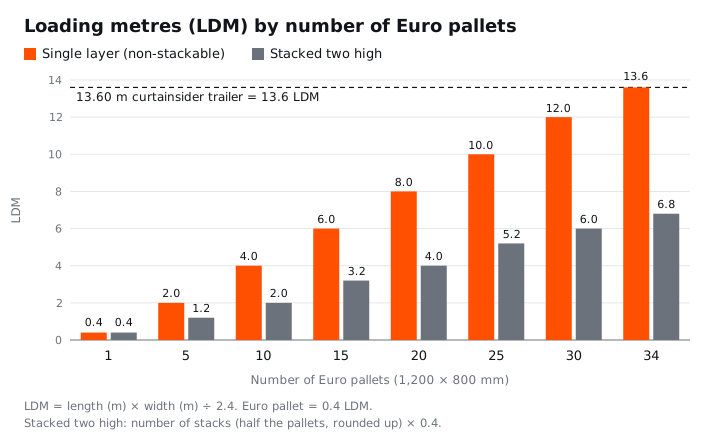
Stackability is the biggest single lever on LDM: pallets that can be stacked two high take roughly half the loading metres of non-stackable ones. Ten Euro pallets are 4 LDM in one layer and 2 LDM stacked. A full set of 34 Euro pallets fills a 13.60 m trailer in one layer (13.6 LDM) but needs only 6.8 LDM when stacked two high. With an odd number, the last stack stays single: 5 pallets stacked two high make 3 stacks, or 1.2 LDM.
Declaring a shipment stackable comes with a physical condition: two loaded pallets on top of each other must fit under the vehicle's internal height. That limit is 2,700 mm in a 13.60 m curtainsider and 3,000 mm in a mega trailer. If the pallet top isn't flat, the product can't take weight, or the packaging can't carry a top load, declare it non-stackable. If the carrier finds at pickup that the goods can't be stacked, they will recalculate the LDM and your invoice will change.
Orientation matters too. The area formula ignores how a piece is turned, but the trailer width does not:
- Nothing of similar size fits beside a piece wider than half the trailer's internal width (1.24 m in a 2,480 mm wide curtainsider). A 3.0 × 1.3 m crate is 1.625 LDM by formula, yet the 1.18 m strip left beside it only takes narrow goods. The carrier may charge the full length, 3.0 LDM.
- For Euro pallets, three lengthwise or two crosswise per row gives the same LDM. On small shipments of one or two pallets, though, whether the rest of that row can be sold to someone else depends on how the carrier loads.
What are the most common LDM mistakes?
The costly mistakes are usually about measurements and declarations, not the formula itself.
- Measuring the pallet instead of the load. If goods overhang the pallet, use the outermost dimensions. A Euro pallet load that overhangs to 1.3 × 0.9 m is about 0.49 LDM, not 0.4.
- Declaring stackable without checking. Stacking halves LDM; a declaration that doesn't hold up at loading means re-measurement and an extra charge.
- Confusing LDM with cubic metres. LDM is floor length and ignores height. A Euro pallet 1.5 m high is 1.44 m³ of volume but still 0.4 LDM.
- Calculating in centimetres. 120 × 80 ÷ 2.4 gives 4,000; convert to metres first.
- Ignoring dead space next to wide items. As in the crate example above, the real LDM can be larger than the formula says.
- Assuming every carrier uses the same factor. The value that turns LDM into weight or volume differs between carriers, so ask for it before comparing quotes.
What should you prepare before requesting a part-load quote?
The carrier calculates LDM from what you tell them; anything missing gets filled in with an assumption or corrected at pickup. Have these ready:
- Quantity and pallet type for each line (Euro, industrial or no pallet)
- Outermost length, width and height of the load
- Gross weight per piece and in total
- Whether it can be stacked, and how many high
- Total LDM and total volume (m³)
- How it will be loaded and unloaded: from the rear or the side? A curtainsider's side curtains open, so forklifts can load it from the side.
How can you calculate LDM automatically?
LDM is easy to work out by hand for a single pallet type. It gets harder with mixed freight: cartons of different sizes, several pallet types, stackable and non-stackable lines in one shipment. Then the area formula only gives a lower bound, and the real load length depends on how the pieces actually fit in the trailer.
The free load calculator works without an account. Pick a pallet or carton size and a vehicle; the packing engine places the load piece by piece in your browser and shows how many fit, how many vehicles you need, volume utilisation and the load length in loading metres. When you choose a pallet, it also shows the LDM per pallet.
For full packing lists, mixed products and a shareable loading report, you'd use the planning workspace; what load planning software does explains how that works. Because StowCargo measures load length from the actual placement, the figure you give the carrier is the plan itself rather than an estimate.
Conclusion
The loading metre rests on a simple formula: length × width ÷ 2.4. What makes the number right is measuring the outermost dimensions, declaring stackability honestly and allowing for the dead space beside wide items. Before you ask for a quote, prepare LDM, weight and volume together, and ask the carrier which one they will charge on.
To see how many loading metres your pallets or cartons take, try the free load calculator. For multi-line shipments and team planning, see the plans on the pricing page.