Reefer Container Loading: Airflow, Load Line, Capacity
A reefer doesn't cool cargo, it holds it at temperature, and it can only do that if air can flow under the load and back over the top. A loading checklist from carrier guidance, internal dimensions and engine-measured capacity.
· 9 min read
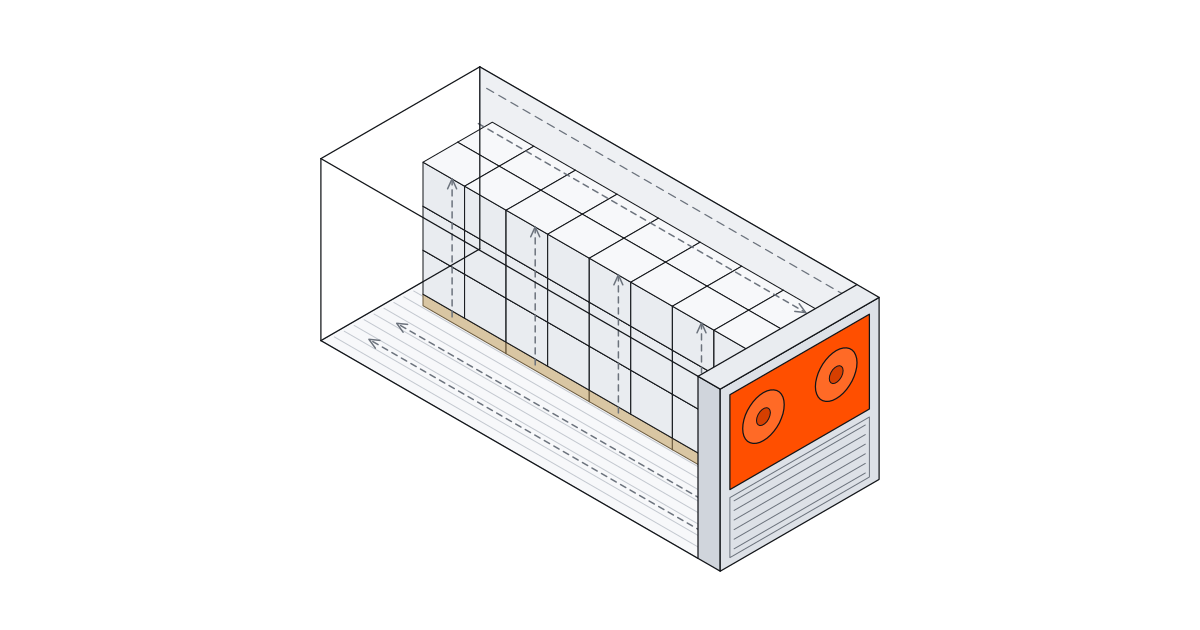
A reefer container doesn't cool cargo down; it keeps it at the temperature it was loaded at. The unit blows cold air into the T-shaped floor, the air rises through or around the cargo, and it returns to the unit through the gap between the load and the roof. Loading a reefer properly means keeping that path open: stay below the red load line, don't load past the end of the T-floor, cover open floor, and load the product at carrying temperature.
On capacity, with our app's internal dimensions a 20ft reefer takes 10 Euro pallets or 262 cartons of 600 × 400 × 400 mm, and a 40ft reefer high cube 23 Euro pallets or 626 cartons. When the load line cuts usable height, those numbers drop in steps; we measured how much below.
Reefer loading checklist
The points below come from two carrier sources: Hapag-Lloyd's Special Handling for Reefer Containers and Blue Water Shipping's reefer loading recommendations (rev. 2, May 2025). Your shipping line's own instructions take precedence.
- Product at carrying temperature. Hapag-Lloyd asks that product temperature equal the transport temperature before stuffing starts, ideally with cargo coming from a refrigerated loading bay. The container isn't built to pull down warm cargo.
- Clean box, working unit. Don't accept a dirty or smelly reefer from the depot.
- Packaging that breathes. Plastic wrap can act as a vapour barrier and block the air circulation the product may need.
- Unit off while loading, back on once the doors are closed (Hapag-Lloyd).
- Nothing above the red load line. The space above it is the return air path.
- Nothing beyond the T-floor, at the front or at the doors. Cargo touching the doors blocks airflow and leads to icing (Blue Water).
- Don't load on the baffle plate below the unit, and don't push it back against the wall. It directs air into the T-floor.
- Cover open floor. Hapag-Lloyd says gaps should not exceed 5% of the floor area and should be filled with board or dunnage. Blue Water recommends cardboard where pallets don't cover the whole T-floor.
- No space between load units in front of the unit's air outlet.
- Secure the load, then check settings. Temperature, humidity and ventilation set points go in for the cargo, the doors are closed properly, and the unit is switched on.
How air moves in a reefer
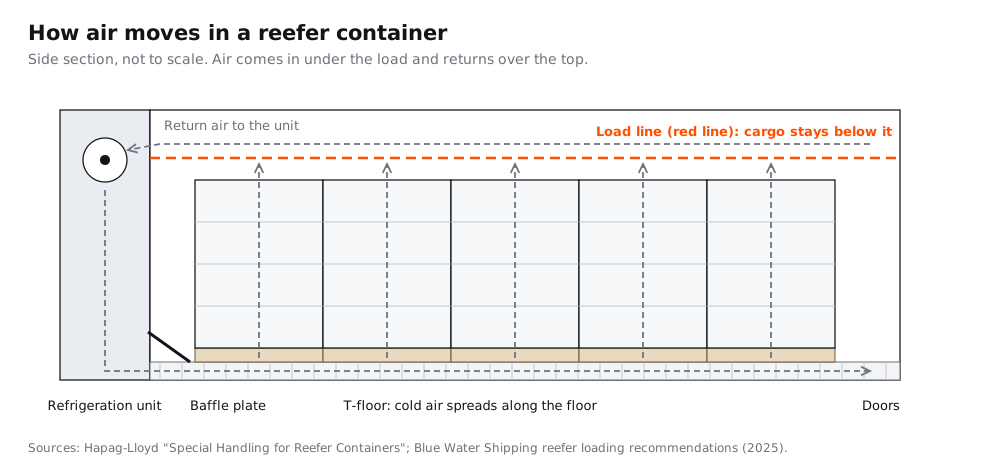
A reefer floor isn't flat. Aluminium T-profiles form channels that carry the unit's cold air along the container. The air comes up out of those channels into the load and travels back over the top to the unit. Three practical consequences:
- Keep the underside open. Pallets take air from the T-floor. If you floor-load without pallets, make sure the packaging or anything laid under it doesn't block the T-floor channels.
- Keep the top clear. Cartons above the line choke the return air.
- Open floor sends air the wrong way. Air takes the easiest route. An uncovered stretch of floor lets it return to the unit without passing through the cargo.
Blue Water's guidance also separates chilled and frozen cargo. Chilled cargo needs air flowing through the load to carry away the heat the product gives off; frozen cargo needs air flowing around it to keep the temperature even. Product-specific temperature, humidity and ventilation settings depend on the commodity, so they're set by the shipper and carrier and we don't publish a table here.
Reefer container dimensions and capacity
| Unit | Internal size (mm) | Volume (m³) | Max payload (kg) | Euro pallets | Industrial pallets | Cartons 600 × 400 × 400 |
|---|---|---|---|---|---|---|
| 20ft reefer | 5,444 × 2,294 × 2,276 | 28.42 | 27,400 | 10 | 9 | 262 (88.5%) |
| 40ft reefer high cube | 11,583 × 2,294 × 2,554 | 67.86 | 29,000 | 23 | 20 | 626 (88.6%) |
| Reefer trailer (road) | 13,300 × 2,460 × 2,600 | 85.07 | 22,000 | 33 | 26 | 858 (96.8%) |
| For comparison: 20ft dry | 5,898 × 2,352 × 2,393 | 33.20 | 28,200 | 11 | 10 | 282 |
| For comparison: 40ft high cube | 12,032 × 2,352 × 2,698 | 76.35 | 26,500 | 25 | 22 | 700 |
Pallet and carton counts come from the StowCargo packing engine: pallets single-tier, cartons in any orientation, best of four seeds. Dimensions are the app's planning values. Reefer units and insulation vary by manufacturer, so check the internal size of the actual box you're given.
Insulation and the machinery make a reefer smaller than the dry box of the same length: the 40ft reefer high cube takes 2 fewer Euro pallets and 74 fewer cartons than a 40ft high cube. Layouts and drawings are on the vehicle pages for the 20ft reefer, 40ft reefer high cube and reefer trailer. How the m³ figures work, and why you never fill all of them, is covered in container CBM calculation.
How much does the load line cost you?
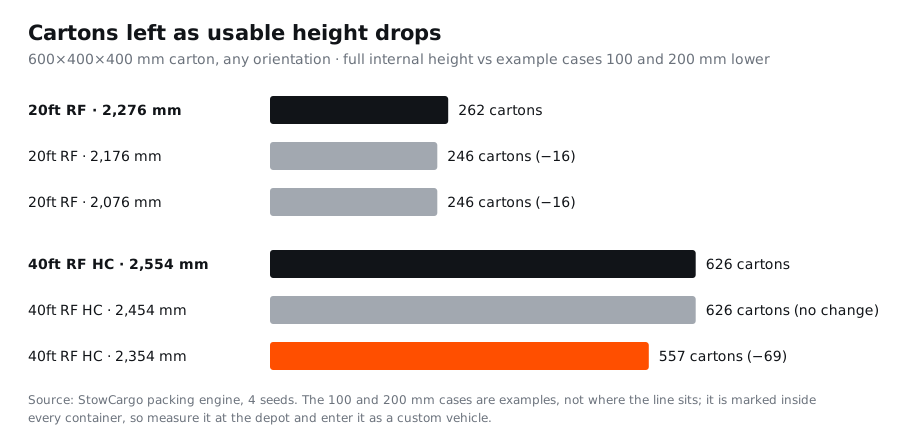
The carton counts above use the full internal height. The red load line sits below the roof, so usable height is lower. Where exactly it sits varies by container and it's marked inside, so we don't quote one figure. Instead we measured what happens when usable height drops by 100 and 200 mm: same method, 600 × 400 × 400 mm cartons, any orientation, a custom vehicle with the reduced height.
| Container | Usable height (mm) | Cartons | vs full height |
|---|---|---|---|
| 20ft reefer | 2,276 (full) | 262 | |
| 20ft reefer | 2,176 | 246 | −16 |
| 20ft reefer | 2,076 | 246 | −16 |
| 40ft reefer HC | 2,554 (full) | 626 | |
| 40ft reefer HC | 2,454 | 626 | no change |
| 40ft reefer HC | 2,354 | 557 | −69 (11%) |
The loss comes in steps, not gradually. In the 40ft reefer high cube, six layers of a 400 mm carton make 2,400 mm, so at 2,454 mm all six layers still fit and nothing is lost. At 2,354 mm the sixth layer is gone and 69 cartons with it. In the 20ft reefer, at full height the engine mixes cartons standing 400 mm and 600 mm tall to build the load up to 2,200 mm and reaches 262. Take away 100 mm and 2,200 mm no longer fits, the load tops out at 2,000 mm and the count drops to 246, where it stays at minus 200 mm.
In practice: measure the height of the line from the floor at the depot and plan to that. In the workspace you can set up a custom vehicle with the line height as its internal height and get a layout that respects it. If your carton height is close to a layer boundary, a few centimetres decide whether you gain or lose a whole layer.
How much of the T-floor do pallets cover?
We set Hapag-Lloyd's 5% gap limit against the pallet counts. Covered area is pallets × pallet footprint; the rest is open T-floor.
| Container | Floor (m²) | Pallets | Covered | Open |
|---|---|---|---|---|
| 20ft reefer | 12.49 | 10 Euro (9.60 m²) | 76.9% | 23.1% |
| 20ft reefer | 12.49 | 9 industrial (10.80 m²) | 86.5% | 13.5% |
| 40ft reefer HC | 26.57 | 23 Euro (22.08 m²) | 83.1% | 16.9% |
| 40ft reefer HC | 26.57 | 20 industrial (24.00 m²) | 90.3% | 9.7% |
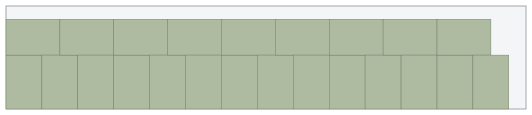
In none of the four cases do the pallets cover 95% of the floor. Maximising the pallet count isn't enough on its own: the open strips need covering with cardboard, board or dunnage. Industrial pallets (1,200 × 1,000) sit better across a reefer's 2,294 mm width than Euro pallets; if you have the choice, they leave less floor to cover. Pallet sizes are covered in our Euro pallet dimensions guide.
Weight: too much and too little
The app's payload is 27,400 kg for a 20ft reefer and 29,000 kg for a 40ft reefer high cube. For dense cargo such as frozen meat or liquids, check the weight before the volume. Every container going by sea also needs a verified gross mass (VGM).
Too little weight is a risk too. Hapag-Lloyd points out that the unit is often without power at the gate and during loading and discharge, and that a light load has little thermal mass to hold its temperature. To limit temperature deviation it recommends at least 3,000 kg in a 20ft reefer and 5,000 kg in a 40ft reefer. If you're shipping a half-empty reefer, talk to the line about it.
A block-stowed load still needs securing so nothing can shift between pallets. See load securing under EN 12195-1.
What this article doesn't cover
- Product-specific temperature, humidity and ventilation. These depend on the commodity, its ripeness and the voyage length; the shipper and carrier set them.
- Pre-cooling the container itself. The right answer depends on the loading dock and the line's instructions; if the container door opens onto ambient air, ask your carrier.
- Road reefer trailers. The air system can differ; for dimensions and capacity see trailer types and dimensions.
- What the engine models. StowCargo plans to the internal dimensions. It doesn't model the T-floor length or the air channels, so measure the load line height and T-floor length yourself and enter them as the vehicle size.