Multi-drop load planning: loading by delivery sequence
Loading by delivery sequence means last in, first out. The same 9,160 kg list took 9.5 m as a single drop and 10.0 m with three drops; once the list approached a full trailer, the drop order cost a second truck.
· 9 min read
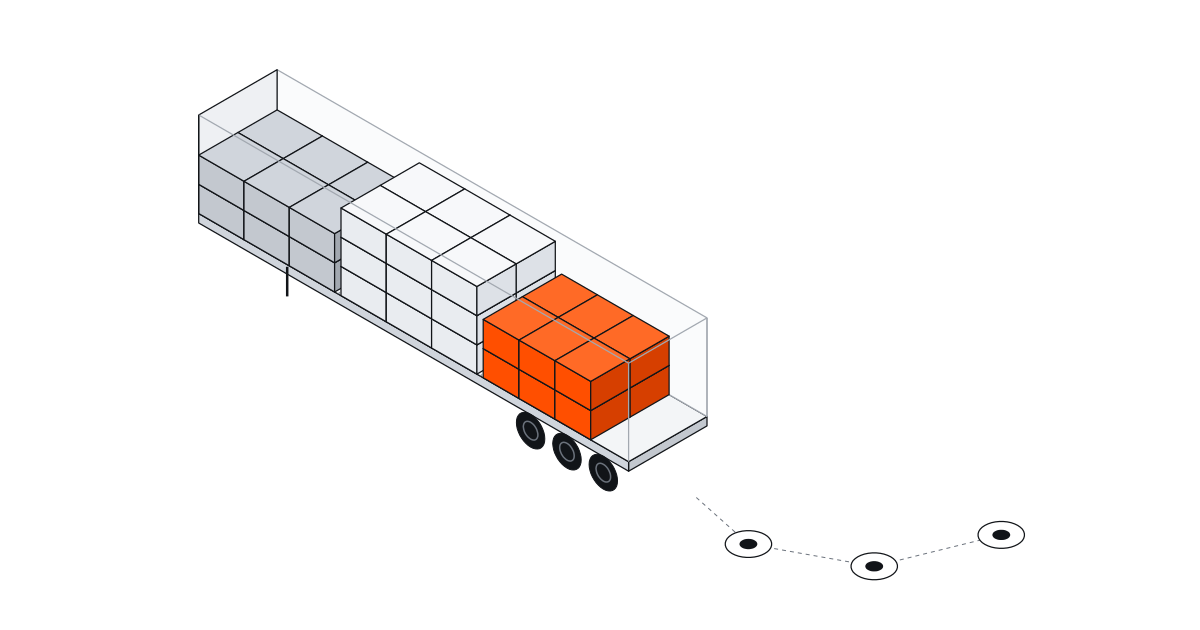
In a multi-drop load the rule is simple: the last drop goes against the headboard, the first drop at the doors. Last in, first out. Each drop's goods stay in their own zone, and nothing for a later drop may block the way to, or sit on top of, goods for an earlier one.
That rule has a price you can measure. We planned the same list with the StowCargo packing engine as a single drop and as three drops: 9.5 m of load length for one drop, 10.0 m for three. As the list approaches a full trailer the price can become a vehicle: at 1.4 times the size, the list fitted one trailer as a single drop and needed a second truck with three.
Measured: the same list with one to four drops
We built a four-line home textiles shipment of 9,160 kg. The figures are an example chosen for the test.
| Line | Outer size (mm) | Gross kg | Qty | In the three-drop plan |
|---|---|---|---|---|
| Towel carton | 600 × 400 × 400 | 12 | 260 | D1 (first drop) |
| Bed linen carton | 500 × 400 × 300 | 7.2 | 200 | D2 |
| Bathrobe pallet | 1200 × 800 × 1400 | 420 | 6 | D2 |
| Ceramics carton | 800 × 600 × 400 | 26 | 80 | D3 (last drop) |
In total 546 pieces, 60.38 m³ (66.3% of the trailer's volume) and 9,160 kg. Method: a 13.60 m curtainsider with inside dimensions of 13,600 × 2,480 × 2,700 mm and 24,000 kg payload (the app's planning values), app defaults (space priority, cartons upright, load against the front wall and right side wall), four seeds, fewest vehicles and then shortest load length.
| Drop layout | Load length |
|---|---|
| Single drop | 9.5 m |
| 2 drops: towels D1, everything else D2 | 9.9 m |
| 3 drops: towels D1, linen and pallets D2, ceramics D3 | 10.0 m |
| 4 drops: pallets as a separate D4 | 10.0 m |
| 3 drops, pallets with the ceramics in D3 (at the headboard) | 10.2 m |
| 3 drops, pallets with the towels in D1 (at the doors) | 9.9 m |
The first split costs the most: going from one drop to two added 0.4 m, the third and fourth drops another 0.1 m. Which drop the pallets belong to moves the result by 0.3 m: 9.9 m in D1 at the doors, 10.2 m in D3 at the headboard. Even on the same route, where large and tall items travel shows up in the plan.
Inside the plan: the drop boundary isn't a straight wall
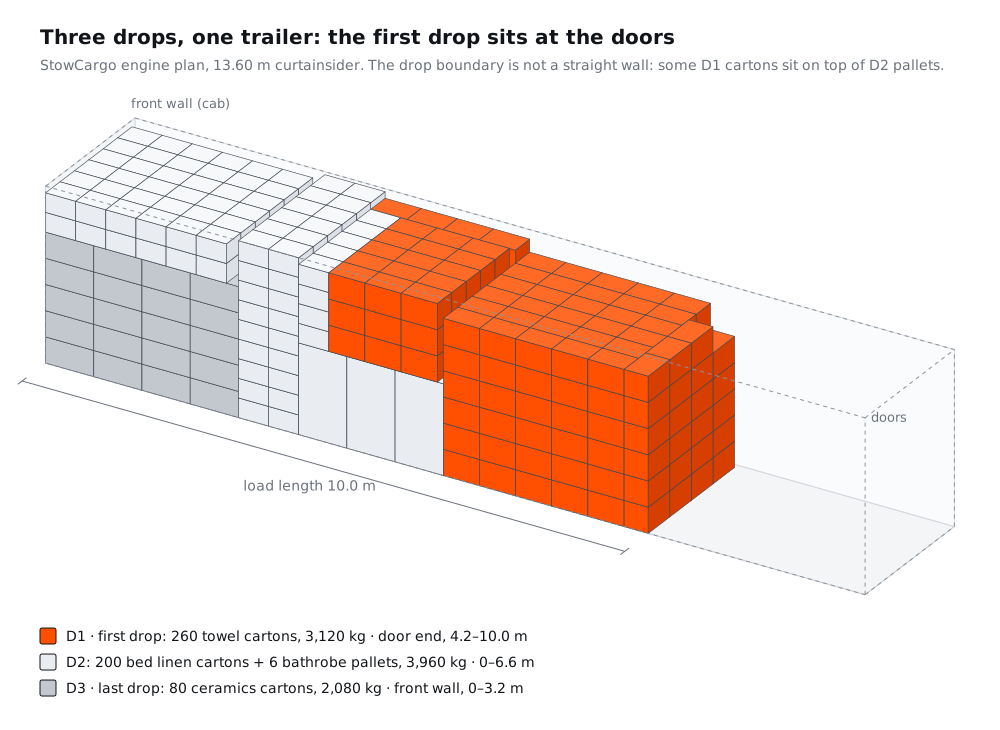
The zones look like they run in order along the trailer, but they overlap. D3's ceramics run from the headboard to 3.2 m, D2's goods from 0 to 6.6 m and D1's towels from 4.2 to 10.0 m. The overlap comes from the bathrobe pallets: D2's six pallets stand on the floor between 4.2 and 6.6 m and D1's towel cartons sit on top of them. At the first drop the cartons come off the pallets, and at the second drop the pallets are free.
The StowCargo engine builds this layout with two rules:
- Goods for an earlier drop may sit on goods for a later drop, never the other way round. A D1 carton can go on a D2 pallet; a D2 carton can't go on a D1 carton.
- In the same lane, earlier-drop goods can't be on the cab side. Within the same width and height band, D2 or D3 goods may be behind a D1 carton (towards the cab) but not in front of it (towards the doors).
These two rules waste less space than splitting the trailer into straight sections, which is why the measured cost stayed at 0.5 m.
Four rules for loading by delivery sequence
- Fix the route before loading. The drop sequence sets the loading sequence; if the route changes after the doors close, the load is in the wrong order. Put the drop number on the packing list as its own column.
- Last drop at the headboard, first drop at the doors. Every drop in between follows its own place in the sequence. No drop's goods should block a later drop's goods from the front or from above.
- Don't split an order. One consignee's goods belong in one vehicle and together. An order with half at the headboard and half at the doors means unloading someone else's goods to reach it.
- Mark the drop on the carton. A loader holding a carton should see which drop it belongs to. Most mistakes at the dock happen with cartons of the same size going to different consignees.
Side access on a curtainsider
With the curtains open, a forklift can unload a curtainsider from the side. For a drop unloaded from the side, the order along the trailer matters less: a pallet near the headboard can still be reached. Stacking order still matters, though; later-drop goods must not sit on top of earlier-drop goods. StowCargo plans the sequence for unloading through the rear doors and doesn't model side unloading separately. Access by trailer type is covered in trailer types and dimensions.
When the trailer is nearly full, sequencing can cost a vehicle
We scaled the same list at the same proportions and measured again:
| List | Single drop | Three drops |
|---|---|---|
| ×1 (546 pieces, 9,160 kg, 66.3% of volume) | 9.5 m | 10.0 m |
| ×1.3 (710 pieces, 11,992 kg, 86.5%) | 12.4 m | 13.0 m |
| ×1.4 (764 pieces, 12,656 kg, 92.2%) | 13.2 m, 1 truck | 2 trucks: 13.6 + 0.4 m |
At 1.4 times, a single drop fits one trailer at 13.2 m. With three drops, 15 towel cartons are left for a second truck. We tried two more options:
- Merge D2 and D3 into one drop: still 2 trucks, with 6 towel cartons in the second.
- Mega trailer (3.0 m inside height) with three drops: 1 vehicle, 12.3 m.
The practical takeaway: for a multi-drop list near 90% of the trailer's volume, don't quote on the assumption of one truck. Plan it first. Whether a few leftover cartons are cheaper in a separate vehicle, a taller trailer or as a part load for one drop is a comparison worked through in FTL vs LTL.
At every drop the centre of gravity moves forward
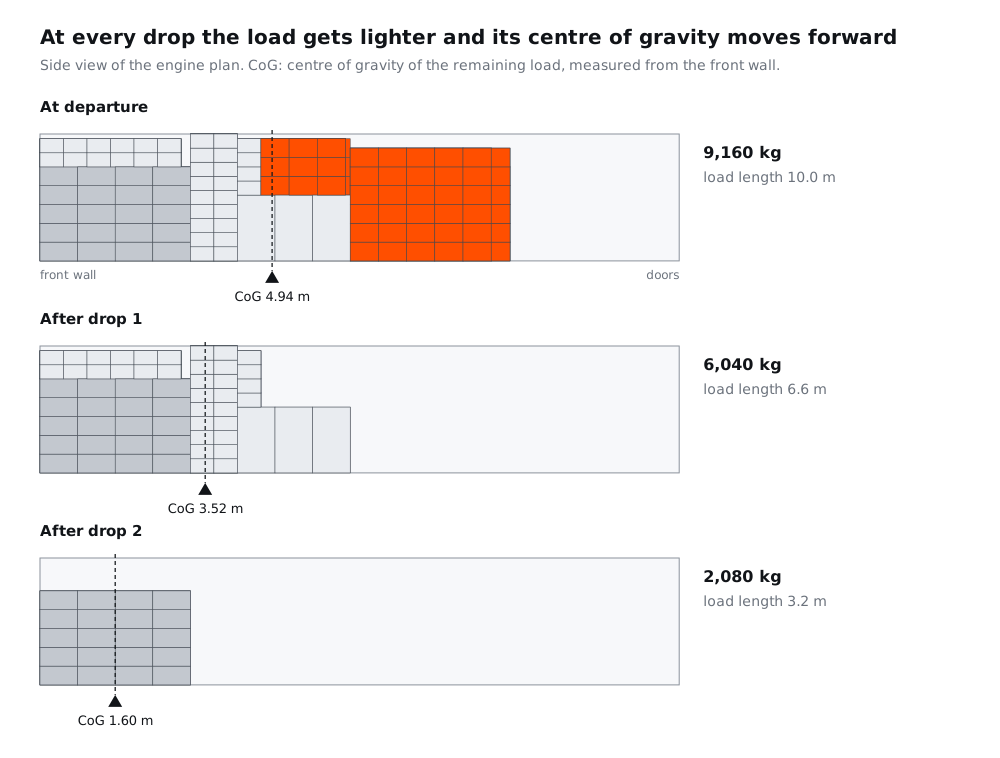
As goods come off at the doors, what remains gets lighter and moves forward. In the plan we measured:
| Stage | Remaining load | Load length | Centre of gravity (from front wall) |
|---|---|---|---|
| Departure | 9,160 kg | 10.0 m | 4.94 m |
| After drop 1 | 6,040 kg | 6.6 m | 3.52 m |
| After drop 2 | 2,080 kg | 3.2 m | 1.60 m |
On an articulated vehicle this means a larger share of the remaining load sits on the kingpin, and so on the tractor, while the trailer axles carry less. A distribution that was fine at departure changes along the route. For international traffic in the EU, the weight on the driving axle must be at least 25% of the vehicle combination's total laden weight (Directive 96/53/EC, Annex I, point 4.1), and that applies on every leg, not just the first. Where heavy goods go to the last drop, at the headboard, check the load on the tractor at departure as well.
StowCargo's axle load estimate covers the loaded plan, meaning the departure state; it doesn't calculate the intermediate stages. The method and its limits are explained in axle load calculation. For firm figures, ask your carrier and use a weighbridge.
Where the plan stops helping
- Re-secure after every drop. Once the first drop is off, there can be metres of empty floor at the doors and the remaining load is no longer blocked from behind. Plan securing for each leg, not only for departure: see load securing under EN 12195-1.
- A route change on the road leaves the load in the wrong order. If the plan changes before loading, the sequence numbers change too, so reprint the labels; the warehouse screen warns when an old label is scanned against a new plan.
- There is a limit to the number of drops. The app takes up to 9 delivery points per plan. Split a longer round into more than one plan.
- Same carton size, different consignee. The engine puts each carton in the right zone, but on the dock it's the label that matches a carton to its consignee. Keep consignee and drop as separate columns on the packing list.
Multi-drop plans in StowCargo
- Drop field: each line takes a drop number from 1 to 9; 1 is unloaded first and sits nearest the doors. On Excel or CSV import a "Drop" column does the same, and lists sent from an ERP carry order and drop fields (ERP integration).
- Order / set field: lines with the same name go into the same vehicle together, so one consignee's order isn't split across vehicles.
- Drop colours in 3D: the "By delivery stop" colour mode shows the D1, D2 and D3 zones in the plan.
- Sequence labels: in a multi-drop plan, carton and pallet labels carry the drop (D1, D2…).
- Warehouse screen: on the step-by-step warehouse loading screen each step shows where the next piece goes and which drop it belongs to; the loader builds from the headboard towards the doors, last drop first.
To test your own route, import the packing list into the workspace, give each line its drop number and plan the same list once more as a single drop. The difference between the two plans is what that route costs you in trailer space.