How many pallets fit in a van or light truck?
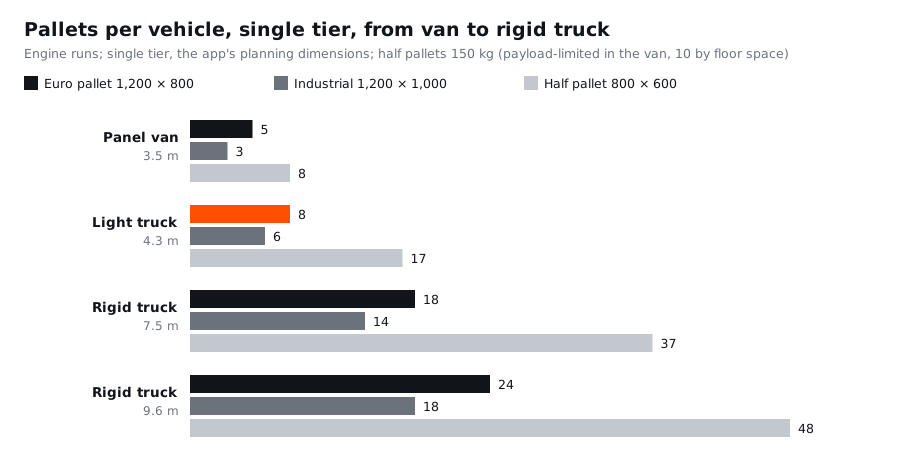
A long-wheelbase panel van takes 5 Euro pallets and a 4.3 m light truck 8, but in small vehicles payload usually runs out before floor space. Engine-measured counts for pallets, half pallets and cartons, compared with rigid trucks.
· 9 min read
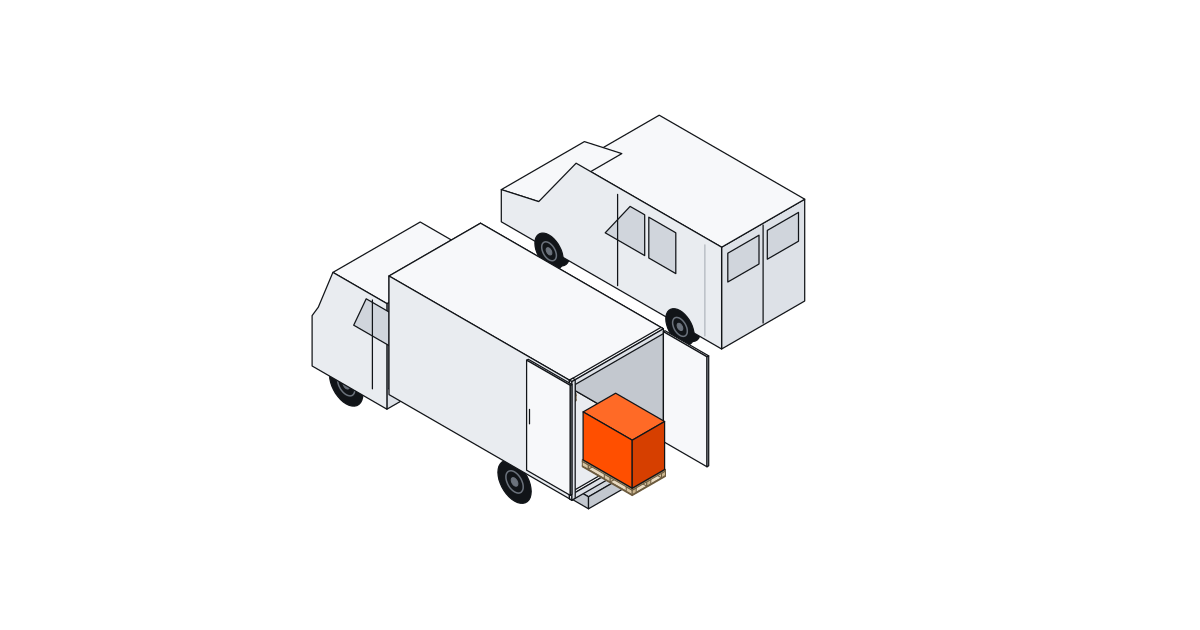
With the app's planning dimensions, a long panel van (3.5 m load floor) takes 5 Euro pallets, 3 industrial pallets or 100 cartons of 600 × 400 × 400 mm. A light truck with a 4.3 m box takes 8 Euro pallets, 6 industrial pallets or 190 cartons. In small vehicles, weight usually runs out first: 8 pallets in a 3,500 kg light truck can average no more than 437.5 kg each, and 5 pallets in a 1,300 kg van no more than 260 kg.
The comparison below puts both next to the next two sizes up, a 7.5 m and a 9.6 m rigid truck. Every count is a StowCargo engine run: the app's own engine, default settings, four seeds, best result kept. Pallets single tier; cartons may be laid on their side.
| Vehicle | Inside (L × W × H, mm) | Payload | Euro pallets | Industrial pallets | Half pallets | Cartons 600 × 400 × 400 |
|---|---|---|---|---|---|---|
| Panel van (long) | 3,500 × 1,750 × 1,800 | 1,300 kg | 5 | 3 | 8 | 100 |
| Light truck | 4,300 × 2,100 × 2,200 | 3,500 kg | 8 | 6 | 17 | 190 |
| Rigid truck 7.5 m | 7,500 × 2,450 × 2,600 | 15,000 kg | 18 | 14 | 37 | 478 |
| Rigid truck 9.6 m | 9,600 × 2,450 × 2,700 | 18,000 kg | 24 | 18 | 48 | 624 |
Half pallets were measured at 800 × 600 mm, 1,000 mm high, 150 kg; in the van, payload capped them at 8 (see below). These are planning values. Vans and light trucks vary far more by make, model and wheelbase than semi-trailers do, so measure your own vehicle before you promise a customer a delivery (how to do that is at the end).
Eight pallets in a 2.1 m wide box
Two Euro pallets side by side on their long edges need 2,400 mm, so they do not fit a 2,100 mm box. All pallets the same way round gives 6. The engine mixes orientations: one lane crosswise, one lengthwise, 1,200 + 800 = 2,000 mm wide. The crosswise lane takes 5 pallets (5 × 800 = 4,000 mm), the lengthwise lane 3 (3 × 1,200 = 3,600 mm): 5 + 3 = 8 pallets, 4.0 m of load length.
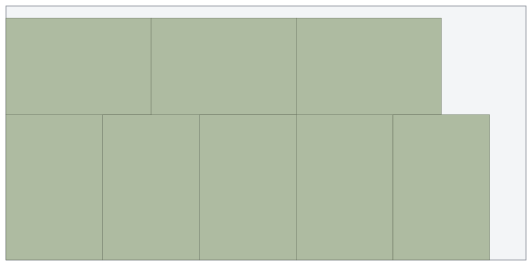
The forklift has to pick pallets from two sides for this pattern. The Euro pallet takes forks from all four sides, so it works; give the dock team the plan drawing so they load the lanes in the right order.
Five pallets in a van, if the wheel arches allow
In a 1,750 mm wide van, two Euro pallets fit side by side on their 800 mm edges (1,600 mm). Two rows use 2,400 mm and one more pallet goes crosswise into the remaining 1,100 mm: 4 + 1 = 5 pallets, 3.2 m of load length.

This is where most van plans go wrong. The rear wheel arches intrude into the load floor, and the width between them is less than the body width. If it is under 1,600 mm, two pallets no longer fit side by side and the count drops. Measure between the arches before anything else.
Payload is the real limit
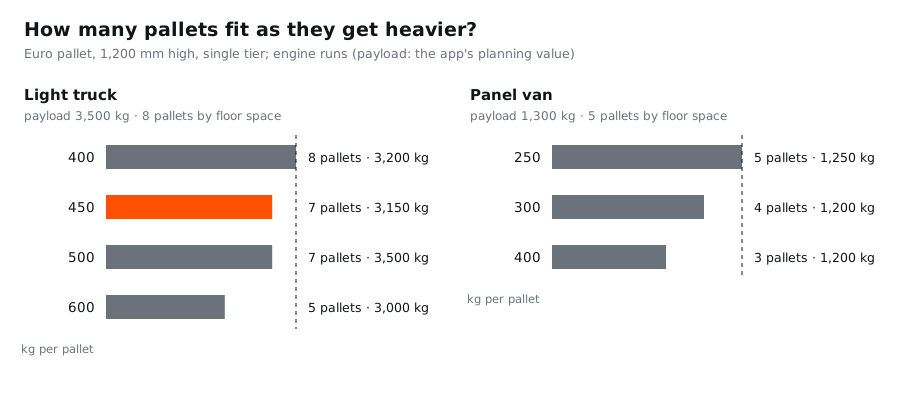
In an articulated truck, weight bites with dense freight. In a van it bites with ordinary pallets. The threshold is payload divided by the floor count: 3,500 ÷ 8 = 437.5 kg in the light truck, 1,300 ÷ 5 = 260 kg in the van. We varied pallet weight in the engine (Euro pallet, 1,200 mm high, single tier):
| Vehicle | Pallet weight | Pallets | Total |
|---|---|---|---|
| Light truck | 400 kg | 8 | 3,200 kg |
| Light truck | 450 kg | 7 | 3,150 kg |
| Light truck | 500 kg | 7 | 3,500 kg |
| Light truck | 600 kg | 5 | 3,000 kg |
| Panel van | 250 kg | 5 | 1,250 kg |
| Panel van | 300 kg | 4 | 1,200 kg |
| Panel van | 400 kg | 3 | 1,200 kg |
Cartons behave the same way. At 15 kg per 600 × 400 × 400 mm carton, the van takes 86 instead of 100 (1,290 kg); at 20 kg, the light truck takes 175 instead of 190 (3,500 kg).
The payload figures above are planning values. For your own vehicle, take the gross vehicle weight from the registration document and subtract the kerb weight; the driver, fuel and anything that lives in the van come off that number too.
Do half pallets help in small vehicles?
A half pallet (800 × 600 mm) covers half the floor of a Euro pallet and leaves less dead space in a narrow box. The light truck took 17 half pallets: 17 × 0.48 = 8.16 m², or 90.4% of the floor. Eight Euro pallets cover 7.68 m², 85.0%.
In the van, weight changes the picture. With 100 kg half pallets the floor took 10; at 150 kg the 1,300 kg payload cut that to 8 (a ninth would make 1,350 kg). According to EPAL's half pallet (EPAL 6) data, the pallet is 800 × 600 × 144 mm with a 750 kg safe working load, so in a van the vehicle sets the limit, not the pallet.
How many boxes fit in a van?
It depends on the carton size and whether cartons may be laid on their side. Four common sizes, laying down allowed:
| Carton (mm) | Panel van | Light truck | Rigid 7.5 m | Rigid 9.6 m |
|---|---|---|---|---|
| 600 × 400 × 400 | 100 | 190 | 478 | 624 |
| 500 × 400 × 300 | 178 | 330 | 780 | 1,036 |
| 400 × 300 × 300 | 289 | 549 | 1,300 | 1,728 |
| 300 × 200 × 200 | 891 | 1,650 | 3,900 | 5,184 |
If the cartons must stay upright, 600 × 400 × 400 mm gives 88 in the van, 175 in the light truck, 444 in the 7.5 m truck and 576 in the 9.6 m truck. In the light truck, 500 × 400 × 300 mm cartons filled 99.7% of the volume while 600 × 400 × 400 mm stopped at 91.8%: the difference is how evenly the carton divides the box. If cartons go on pallets first, work it out layer by layer as in how many boxes fit on a pallet.
Stacking pallets in small vehicles
It is possible, but the headroom is small and the payload goes fast. For two tiers each pallet, including the pallet, must stay under 1,100 mm in the light truck and 900 mm in the van. Two runs:
- Light truck, 1,000 mm Euro pallets at 200 kg: 16 pallets, 3,200 kg.
- Panel van, 850 mm Euro pallets at 120 kg: 10 pallets, 1,200 kg.
Both only work with pallets far lighter than a typical truckload pallet. Height, payload and carton strength are covered in double stacking pallets.
Van, light truck or rigid?
The choice usually comes down to how many trips an order needs. We planned one order, 16 Euro pallets (1,200 mm, 350 kg, 5,600 kg in total, non-stackable), on four vehicles:
| Vehicle | Vehicles needed | Pallets per vehicle | Note |
|---|---|---|---|
| Panel van | 6 | 3 (1 in the last) | 1,300 kg payload: 3 × 350 = 1,050 kg |
| Light truck | 2 | 8 | 2,800 kg each |
| Rigid truck 7.5 m | 1 | 16 | 6.4 m load length |
| Rigid truck 9.6 m | 1 | 16 | 6.4 m load length |
The van floor holds 5 pallets, but payload cut it to 3 and the order became 6 trips. The light truck did it in 2, the 7.5 m rigid in one. Compare prices with your carrier's quotes, but knowing the trip count before you ask changes the conversation. For the part load versus full load decision, see FTL vs LTL; for trailer-sized vehicles, how many pallets fit in a truck.
Measure your own vehicle
The spread between van models is wider than between semi-trailers. Before planning, measure:
- Floor length: from the bulkhead to the door sill, at floor level.
- Narrowest width: between the wheel arches in a van; the inner box width in a light truck.
- Door opening: width and height of the rear and side doors. If the opening is lower than the interior, size pallet heights to the door.
- Payload: gross vehicle weight minus kerb weight, from the registration document.
Enter these in StowCargo with Define custom vehicle and every plan uses your real vehicle. Drawings and planning dimensions are on the light truck and panel van pages and in the full vehicle and container guide. For a single product you can test it without an account in the free load calculator.
Euro and industrial pallet specs are in our Euro pallet dimensions guide.