Double stacking pallets: when it pays off, measured
If two pallet heights fit under the roof and the weight stays under the payload, a 13.6 m trailer takes 68 Euro pallets instead of 34. We ran the numbers through a load planning engine to see where stacking stops paying off.
· 9 min read
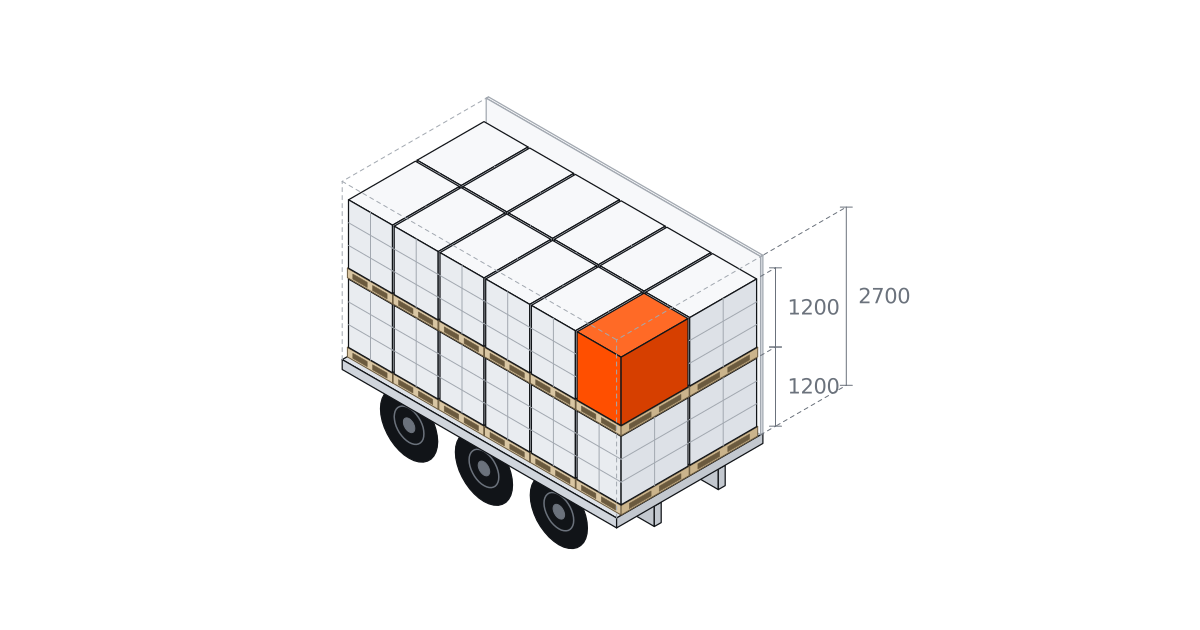
Double stacking doubles the pallet count of a trailer when two pallets fit under the roof and the total stays within the payload: a 13.6 m curtainsider then takes 68 Euro pallets instead of 34. With a 2,700 mm inner height that means each pallet, including the pallet itself, can be at most 1,350 mm high; in a 3,000 mm mega trailer, 1,500 mm. Weight usually bites first: to carry all 68, the average pallet must stay at or below 352.9 kg.
The pallet counts below come from the StowCargo load planning engine: the same engine the app uses, default settings, four seeds per scenario, best result kept. Vehicle dimensions are the app's planning values; a real trailer can differ by a few centimetres depending on the builder.
Two numbers decide it: height and payload
The height rule is 2 × pallet height ≤ inner height. The weight rule is pallet count × pallet weight ≤ payload. A third question, whether the cartons on the bottom pallet can carry the top one, is a packaging question and is covered further down.
We tested four pallet heights in a curtainsider (2,700 mm) and a mega trailer (3,000 mm). Euro pallets (1,200 × 800 mm), 300 kg each, "Stacking rules" priority; in the single-tier column the pallets are marked non-stackable.
| Pallet height (incl. pallet) | Curtainsider, single tier | Curtainsider, stacked | Mega trailer, single tier | Mega trailer, stacked |
|---|---|---|---|---|
| 1,000 mm | 34 | 68 | 34 | 80 (3 tiers, payload-limited) |
| 1,200 mm | 34 | 68 | 34 | 68 |
| 1,350 mm | 34 | 68 | 34 | 68 |
| 1,500 mm | 34 | 34 | 34 | 68 |
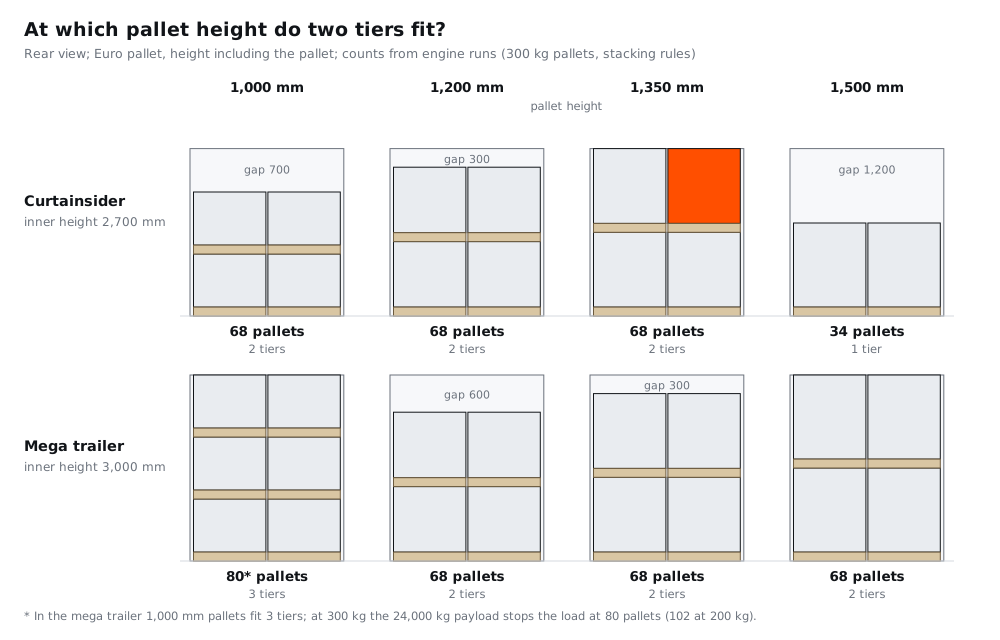
What the table says in practice:
- 1,350 mm fits on paper and nowhere else with confidence. Two tiers make exactly 2,700 mm. A roof bow, a tilt rail or a trailer a couple of centimetres lower than spec leaves the second tier on the dock, and the forklift needs some headroom to set the top pallet down. Plan at this height only with the trailer's measured inner height from your carrier.
- 1,500 mm pallets do not stack in a curtainsider. Two tiers need 3,000 mm, so the trailer stays at 34 pallets. The same load in a mega trailer is 68. The extra 300 mm of a mega trailer adds nothing to single-tier pallet loads; it only pays when you stack.
- Low pallets open a third tier. 1,000 mm pallets go three high in a mega trailer, and at 300 kg the payload, not the roof, sets the limit.
Other vehicles with 1,200 mm pallets
| Vehicle | Inner height | Max per tier (2 tiers) | Single tier | Stacked |
|---|---|---|---|---|
| 9.6 m rigid truck | 2,700 mm | 1,350 mm | 24 | 48 |
| 40 ft high cube | 2,698 mm | 1,349 mm | 25 | 50 |
| 40 ft dry container | 2,393 mm | 1,196 mm | 25 | 25 |
| 40 ft dry container, 1,100 mm pallets | 2,393 mm | 1,196 mm | 25 | 50 |
The 40 ft dry box is the one to remember. Two 1,200 mm pallets need 2,400 mm and miss the 2,393 mm interior by 7 mm. Building the pallets to 1,100 mm takes the box from 25 to 50 pallets. Container interiors are listed in our shipping container dimensions guide. With industrial pallets (1,200 × 1,000 mm, 1,200 mm high, 300 kg) the curtainsider took 26 single-tier and 52 stacked.
Three tiers
Three tiers need pallets no taller than a third of the inner height: 900 mm in a curtainsider, 1,000 mm in a mega trailer.
| Scenario | Pallets | Total weight | Load length |
|---|---|---|---|
| Curtainsider, 850 mm pallets, 200 kg | 102 | 20,400 kg | 13.6 m |
| Mega trailer, 1,000 mm pallets, 200 kg | 102 | 20,400 kg | 13.6 m |
| Mega trailer, 1,000 mm pallets, 300 kg | 80 | 24,000 kg | 10.8 m |
At 200 kg, three tiers use the whole floor. At 300 kg, the mega trailer hits its payload at 80 pallets and the last 2.8 m travel empty. Three tiers also put two pallets on the bottom cartons, so the packaging check below counts double.
When double stacking stops paying off
24,000 kg of payload over 68 pallets is 352.9 kg per pallet. Above that, stacking still adds pallets, just fewer of them. Same curtainsider, 1,200 mm Euro pallets, weight varied:
| Pallet weight | Pallets | Total weight | Load length |
|---|---|---|---|
| 300 kg | 68 | 20,400 kg | 13.6 m |
| 400 kg | 60 | 24,000 kg | 12.0 m |
| 500 kg | 48 | 24,000 kg | 9.6 m |
| 600 kg | 40 | 24,000 kg | 8.0 m |
| 700 kg | 34 | 23,800 kg | 6.8 m |
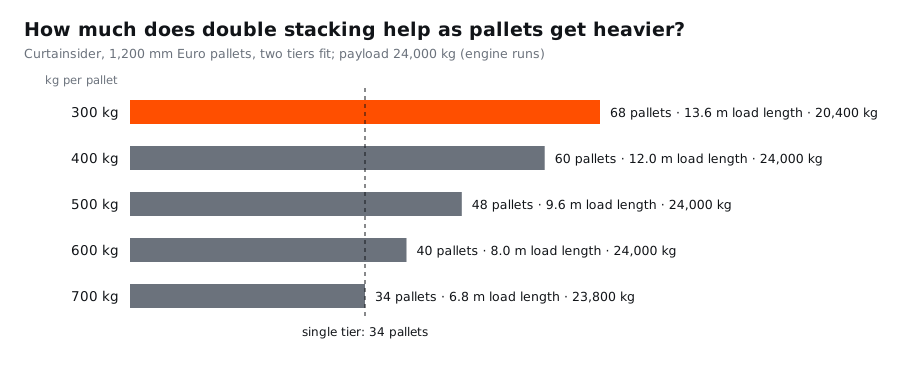
At 700 kg stacking gains nothing: 34 pallets fit on the floor anyway. What changes is where the weight sits. 23.8 t ends up on 6.8 m of floor instead of 13.6 m, and that shifts load between axles; one axle group can be overloaded while the gross weight is legal. Check the axle load calculation before stacking heavy freight; in the app, the plan's "Balance" tab shows the estimate.
So stacking is a tool for light, bulky freight: textiles, packaging, plastics, flat-pack furniture. With dense goods such as ceramics, metal parts or drinks, the gain shrinks or disappears.
Can the bottom pallet carry the top one?
The wooden pallet is rarely the weak point. According to EPAL, the Euro pallet has a safe working load of 1,500 kg, and when laden pallets are stacked on a solid, even surface the bottom pallet may carry up to 5,500 kg (EPAL Euro pallet technical data). A 300 kg pallet on top is well inside that.
The weak point is the cartons on the bottom pallet. The top pallet rests on their top layer. Corrugated board loses strength with humidity and time under load, and braking, cornering and potholes add dynamic load on the road. Stackability is a tested property of the packaging, not a label:
- Ask your packaging supplier for the box compression value (BCT) and compare it with the real load on top, with a margin for humidity and transport.
- The top pallet must sit fully on the load below: same footprint, flat top. An industrial pallet on a Euro pallet leaves its edges unsupported.
- If the top surface is uneven, a flat board between the tiers spreads the load.
- Stretch film and edge protectors keep cartons from bulging; see our load securing guide for the securing side.
How many carton layers sit on the bottom pallet also sets what each carton carries. The layer maths is in how many boxes fit on a pallet.
How the app handles non-stackable pallets
StowCargo plans in Space first mode by default: the goal is the shortest load and the fewest vehicles, and the non-stackable, load-on-top and layer-limit rules are ignored. We measured it. 1,200 mm, 300 kg Euro pallets marked non-stackable and planned in Space first still came out at 68 in a curtainsider, stacked two high. The same list in "Stacking rules" priority stayed at 34.
If your pallets cannot take load, switch priority under Rules → Priority → Stacking rules. Three per-item settings then apply:
- Load on top: Any, Light (up to a given kg) or None.
- Layer limit: how many layers of the same product.
- Placement → Floor only: the pallet is never placed on other cargo; this one applies in Space first too.
A mixed test: 34 heavy pallets (500 kg, at most 300 kg on top) and 34 light pallets (150 kg, nothing on top), all 1,200 mm high. The engine put the light pallets on the heavy ones: 1 trailer, 68 pallets, 22,100 kg. With the heavy pallets also set to None, the load needed 2 trailers (34 + 34). The settings should match what your packaging can really take: a wrong "None" costs a truck, a wrong "Any" costs crushed cartons.
For a single pallet type you can check this without an account in the free load calculator: enter the pallet size, height and weight, then toggle "Can be stacked" and compare the two results.
Stacking and loading metres in groupage
For part loads, carriers often price the floor space you take, in loading metres. Stackable pallets take half the floor: 10 Euro pallets are 4 LDM single tier and 2 LDM double stacked. State stackability and pallet height when you ask for a quote. The formula is in loading metre (LDM) explained; single-tier counts per vehicle are in how many pallets fit in a truck.
Checklist before you stack
- Measure pallet height including the pallet and compare it with half the inner height (curtainsider 1,350, mega 1,500, 40 ft HC 1,349, 40 ft dry 1,196 mm).
- Divide the payload by the pallet count; if your average pallet is heavier, weight is the limit.
- Heavy stacked loads get shorter: check axle loads.
- Get the carton compression strength from your packaging supplier; do not stack on guesswork.
- In your planning tool, use "Stacking rules" for anything that cannot carry load.