Container CBM Calculation: How Many m³ Really Fit?
A 20ft dry container holds 33.2 m³ inside and a 40ft high cube 76.35 m³, but cartons never fill all of it. Across five carton sizes we measured 81.6% to 96.7% fill. The formula, a worked example and the weight check.
· 9 min read
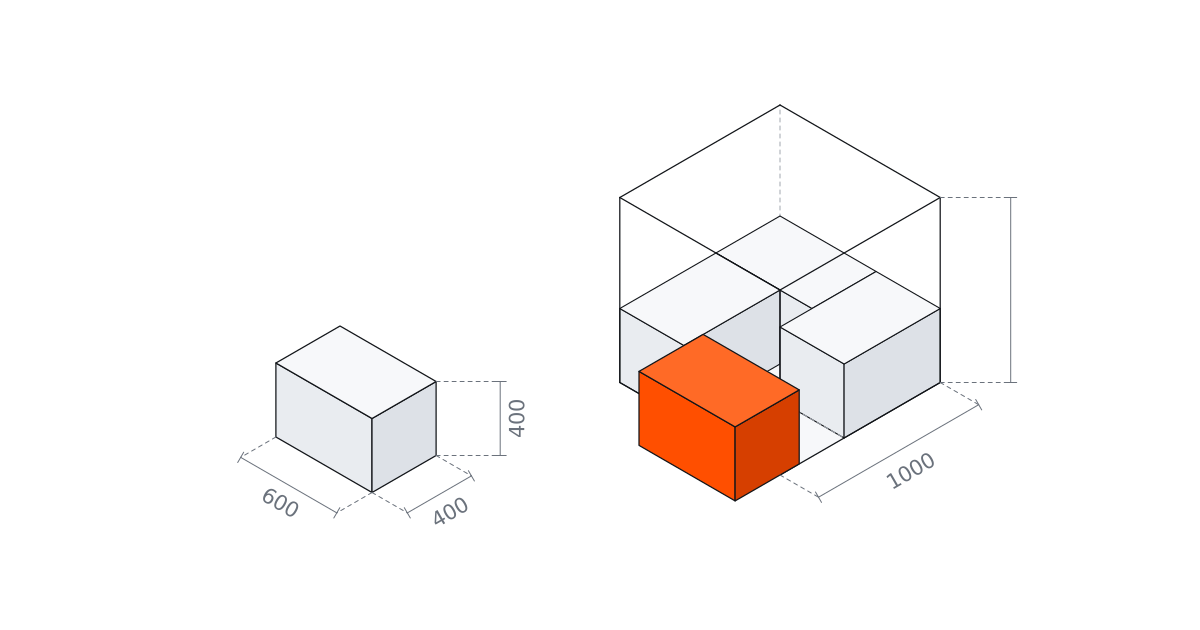
CBM is cargo volume in cubic metres: length × width × height, all in metres. A 600 × 400 × 400 mm carton is 0.6 × 0.4 × 0.4 = 0.096 m³. Multiply by the quantity on each packing list line and add the lines up.
The container's own volume uses the same formula. With the internal dimensions in our app, a 20ft dry container is 33.20 m³, a 40ft dry 67.72 m³ and a 40ft high cube 76.35 m³. Cartons never fill all of that. When we ran five common carton sizes through our packing engine, a 20ft took between 27.07 and 30.60 m³ of cartons and a 40ft high cube between 67.20 and 73.86 m³. Fill ranged from 81.6% to 96.7%, and the carton size made the difference.
How to calculate CBM
- Take the carton's outer dimensions. For palletised goods, use the height including the pallet.
- Convert to metres and multiply. If you work in millimetres, divide the product by 1,000,000,000; in centimetres, by 1,000,000.
- Multiply one carton's volume by the quantity.
- Add up the lines. The total is the CBM of the packing list.
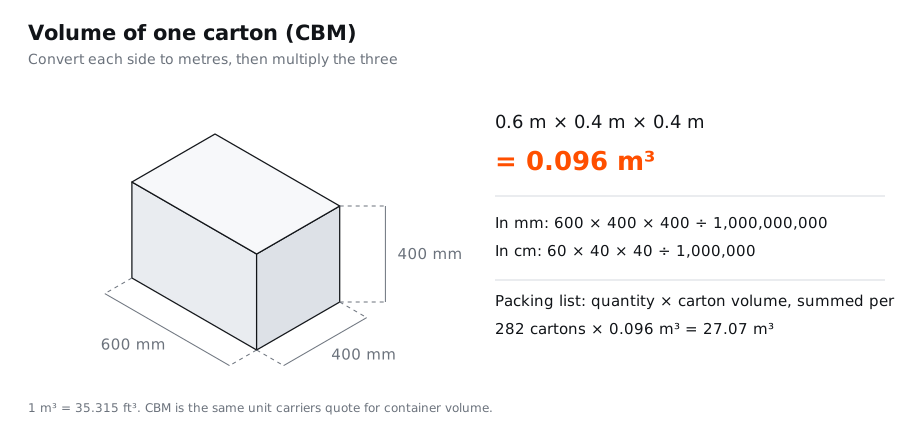
If your supplier quotes inches, divide cubic inches by 61,024 to get m³; for cubic feet, divide by 35.315. Round at the end, not per carton: writing 0.1 instead of 0.096 adds 1.2 m³ over 300 cartons, space that isn't there.
Worked example: a three-line packing list
| Line | Size (mm) | Qty | Carton volume (m³) | Line total (m³) | Weight (kg) |
|---|---|---|---|---|---|
| Carton A | 600 × 400 × 400 | 150 | 0.096 | 14.40 | 1,800 |
| Carton B | 500 × 400 × 300 | 120 | 0.060 | 7.20 | 960 |
| Carton C | 800 × 600 × 450 | 30 | 0.216 | 6.48 | 600 |
| Total | 300 | 28.08 | 3,360 |
The list comes to 28.08 m³, which is 28.08 ÷ 33.20 = 84.6% of a 20ft container. That ratio on its own doesn't tell you whether it fits. We'll come back to what the engine made of this list.
How many CBM in a 20ft and a 40ft container?
| Container | Internal size (mm) | Internal volume (m³) | Max payload (kg) |
|---|---|---|---|
| 20ft dry (DC) | 5,898 × 2,352 × 2,393 | 33.20 | 28,200 |
| 40ft dry (DC) | 12,032 × 2,352 × 2,393 | 67.72 | 26,700 |
| 40ft high cube | 12,032 × 2,352 × 2,698 | 76.35 | 26,500 |
| 45ft high cube | 13,556 × 2,352 × 2,698 | 86.02 | 27,700 |
| 20ft reefer | 5,444 × 2,294 × 2,276 | 28.42 | 27,400 |
| 40ft reefer high cube | 11,583 × 2,294 × 2,554 | 67.86 | 29,000 |
These are the planning values StowCargo uses. Real boxes of the same type differ by a few centimetres and a few hundred kilos of payload depending on the manufacturer. The actual figures for your unit are on its door and CSC plate; use them when a load is close to the limit. For pallet counts per container, see our container dimensions guide.
Internal volume vs what actually fits: our measurements
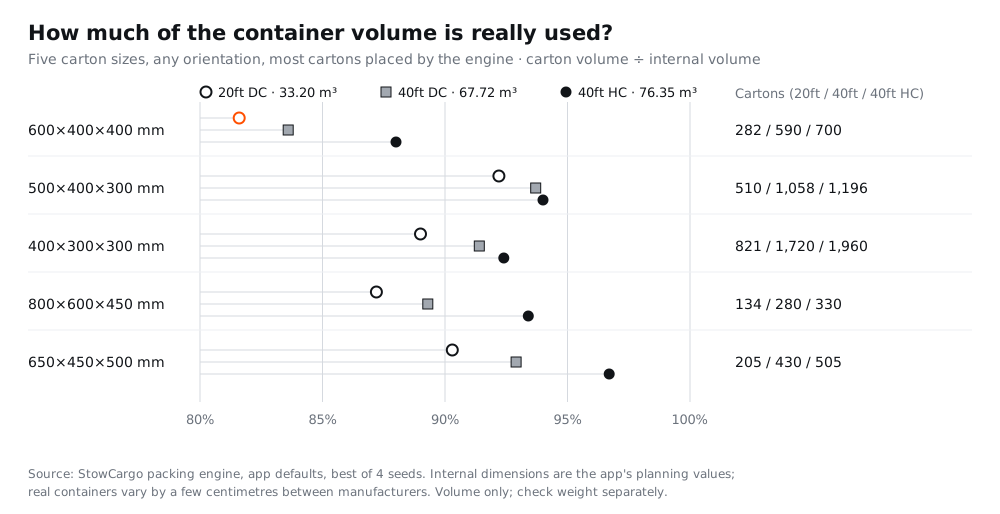
Internal volume describes an empty box. A load plan needs to know how many of your cartons go in. We measured that for five common carton sizes in three container types, using the StowCargo packing engine with the app's default settings, cartons allowed in any orientation, and the best of four seeds. The m³ figure is cartons placed × carton volume.
| Carton (mm) | 20ft DC (33.20 m³) | 40ft DC (67.72 m³) | 40ft HC (76.35 m³) |
|---|---|---|---|
| 600 × 400 × 400 | 282 cartons · 27.07 m³ · 81.6% | 590 · 56.64 m³ · 83.6% | 700 · 67.20 m³ · 88.0% |
| 500 × 400 × 300 | 510 · 30.60 m³ · 92.2% | 1,058 · 63.48 m³ · 93.7% | 1,196 · 71.76 m³ · 94.0% |
| 400 × 300 × 300 | 821 · 29.56 m³ · 89.0% | 1,720 · 61.92 m³ · 91.4% | 1,960 · 70.56 m³ · 92.4% |
| 800 × 600 × 450 | 134 · 28.94 m³ · 87.2% | 280 · 60.48 m³ · 89.3% | 330 · 71.28 m³ · 93.4% |
| 650 × 450 × 500 | 205 · 29.98 m³ · 90.3% | 430 · 62.89 m³ · 92.9% | 505 · 73.86 m³ · 96.7% |
What the numbers say:
- There is no single "usable CBM" for a container. The same 20ft took 27.07 m³ of 600 × 400 × 400 cartons and 30.60 m³ of 500 × 400 × 300 cartons. That's a 3.53 m³ gap, the volume of about 37 of the larger cartons.
- The high cube usually packs better. Its extra 305 mm of height leaves less dead space under the roof. With 600 × 400 × 400 cartons, the 40ft dry reaches 83.6% and the high cube 88.0%.
- Bigger doesn't automatically mean fuller. Fill depends on how evenly the carton divides into the internal dimensions, not on the container's length.
You can run your own carton size against any of these containers in the free load calculator; no account needed. The container pages show the same plans as drawings: 20ft dry, 40ft dry, 40ft high cube.
Why fill never reaches 100%
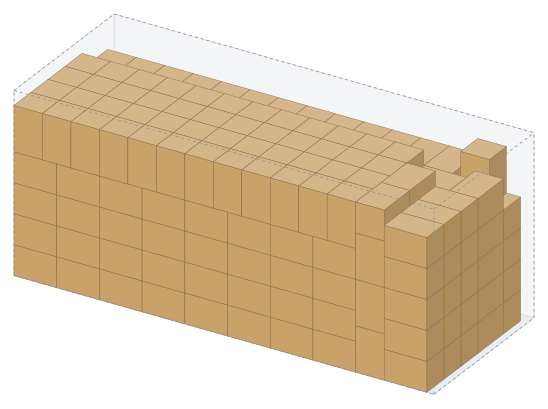
Carton sizes don't divide evenly into the box. A 20ft dry is 2,393 mm high inside. Five layers of a 400 mm carton make 2,000 mm and leave 393 mm under the roof, not enough for a sixth. The engine fills part of that gap with cartons laid on their side, but not all of it. The opposite case is a 650 × 450 × 500 carton in a 40ft high cube: five cartons placed side by side on their 450 mm edge take 2,250 mm of the 2,352 mm width, leaving only 102 mm. That's why the same carton reaches 96.7% in the high cube.
Orientation limits cost space. The table assumes cartons can be laid down. A "this side up" carton can't. We measured the effect in a 13.6 m curtainsider: 816 cartons of 600 × 400 × 400 fit when they had to stay upright, 884 when they could be turned. More on that in our article on truck load utilization.
Doors and the last row. The door opening is narrower and lower than the inside of the box, and the last rows go in by hand or pallet truck. Our figures are based on internal dimensions and don't include that practical loss.
Stacking rules and pallets. Fragile or no-stack lines leave more air. Pallets fit a container worse than cartons do: a 20ft dry takes only 11 Euro pallets.
Does the example list fit a 20ft?
We loaded the three-line list above (300 cartons, 28.08 m³, 84.6%) into a 20ft dry with the same method. Result: one container. With cartons kept upright the load was 5.6 m long; with rotation allowed, 5.4 m.
Now take a smaller list: 288 cartons of 600 × 400 × 400 only. That's 27.65 m³, or 83.3%, less than the mixed list. It doesn't fit, because a 20ft dry takes at most 282 of that carton even with rotation allowed. Less CBM fails, more CBM fits. Mixed sizes can fill the gaps that a single size leaves behind.
A practical rule from these measurements: none of the five carton sizes we tested dropped below 81.6% fill. If your list is under 80% of the container volume, you usually have room to spare. Above that, the answer comes from a load plan, not a CBM total. We tested how far spreadsheet volume ratios can mislead in Excel vs load planning software.
Volume or weight: which runs out first?
CBM is volume. It says nothing about kilos. Cargo density decides which limit you hit first. Divide the maximum payload by the most 600 × 400 × 400 cartons that fit, and you get the heaviest average carton each container can take:
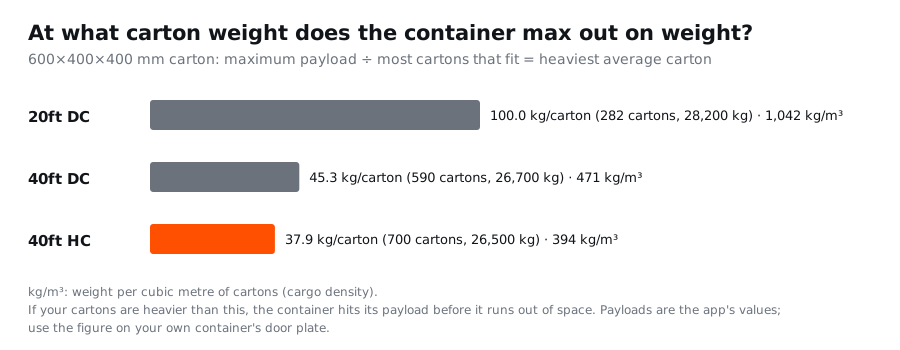
Longer containers max out on weight sooner. A 40ft dry has twice the volume of a 20ft but less payload. In a 40ft high cube, 600 × 400 × 400 cartons averaging more than 37.9 kg hit the payload limit before the box is full.
The engine showed this in our measurements too. A 400 × 300 × 300 mm carton at 5 kg filled a 40ft high cube with 1,960 cartons and 92.4% of the volume. At 15 kg the same carton stopped at 1,766: 26,490 kg, 10 kg under the payload, with only 83.3% of the volume used. For small, heavy cartons, check the weight before you trust a CBM figure.
Containers going by sea also need a verified gross mass; see VGM under SOLAS. Reefers are smaller inside and have their own loading rules: reefer container loading.
When a CBM total is enough, and when it isn't
- For quotes and bookings it's enough. Total m³ and total kg tell you roughly how many containers to book.
- Above about 80% of the container, it isn't. In that range the same CBM fits in one list and fails in another. Test the layout.
- For one carton size, the calculator is enough. For mixed lists, order groups or delivery sequence, you need a full plan. In the workspace you can import the packing list and see the layout container by container. We measured how mixed sizes combine in mixed carton loading.
- Limits of our numbers: All measurements use internal dimensions. Door frames, corrugated walls, bulging cartons and loading tolerance can cost a few cartons in practice. On a tight load, leave a few cartons' margin.