How to Increase Truck Load Utilization: 8 Measured Levers
The same carton fits 816 times in a curtainsider when kept upright and 884 times when it may be turned. 3,000 cartons take 4 trucks floor-loaded and 6 on Euro pallets. Eight levers, their measured effect and when you cannot use them.
· 10 min read
Most of the gain in truck load utilization comes from a handful of loading decisions: letting cartons be turned, floor-loading instead of palletising, switching off stacking rules you do not need, and matching the trailer to the cargo. The same 600 × 400 × 400 mm carton fits 816 times in a 13.6 m curtainsider when it must stay upright and 884 times when it may be turned. A 3,000-carton order takes 4 trucks floor-loaded and 6 trucks once it is built onto Euro pallets.
We measured each of the eight levers below with the StowCargo packing engine and noted when each one is off the table. Results first, details after.
Eight levers, measured
Method: each row is one engine run with the app's default settings, repeated with four random seeds, keeping the best result. Vehicle sizes are the app's planning values (curtainsider 13,600 × 2,480 × 2,700 mm, 24,000 kg payload; mega trailer 13,600 × 2,480 × 3,000 mm). Real trailers differ by a few centimetres between builders.
| # | Lever | Input | Before | After |
|---|---|---|---|---|
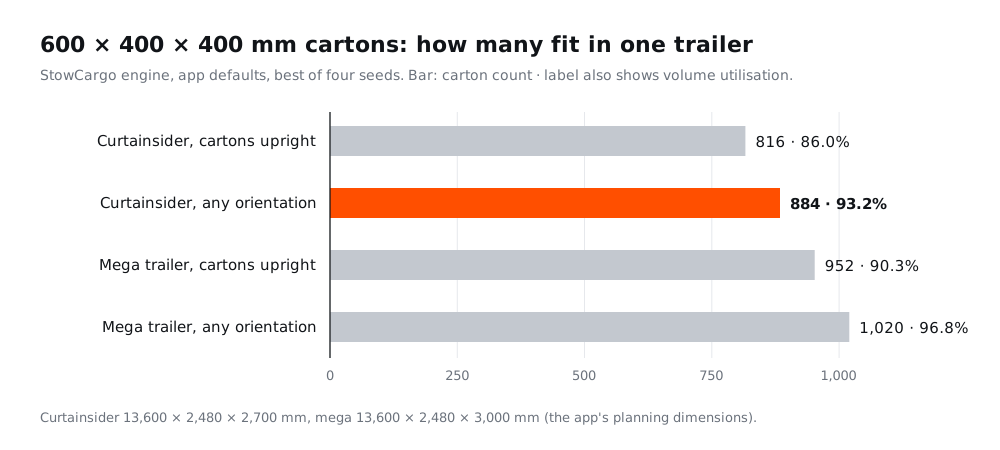
| 1 | Allow cartons to be turned | 600 × 400 × 400 mm carton, curtainsider | Upright: 816 cartons, 86.0% volume | Any orientation: 884, 93.2% |
| 2 | Use a taller trailer | Same carton, upright | Curtainsider: 816 | Mega trailer: 952 |
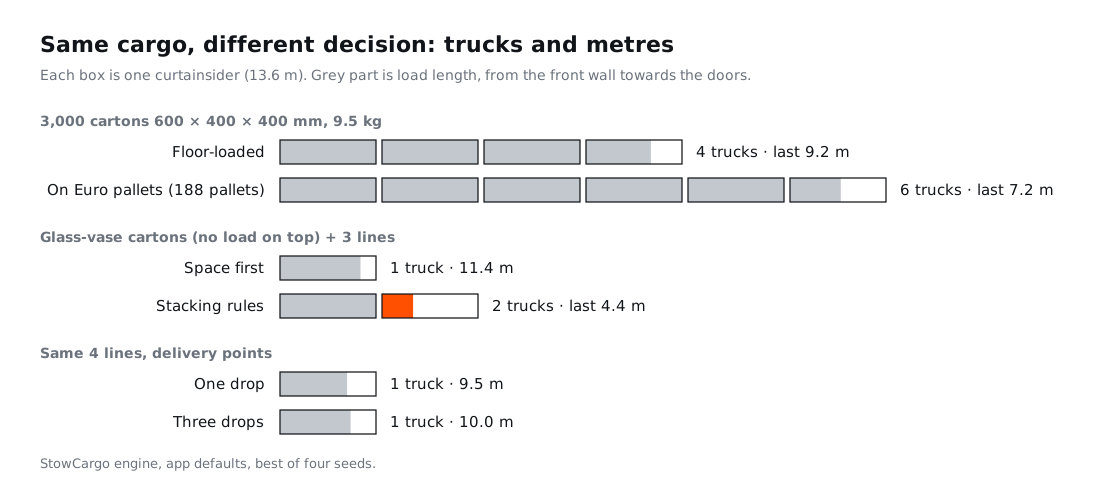
| 3 | Floor-load instead of palletising | 3,000 cartons 600 × 400 × 400 mm, 9.5 kg | On Euro pallets: 188 pallets, 6 trucks | Floor-loaded: 4 trucks, last one 9.2 m |
| 4 | Drop stacking rules you do not need | 4-line list, glass-vase cartons take no load on top | Stacking rules: 2 trucks, second 4.4 m | Space first: 1 truck, 11.4 m |
| 5 | Double-stack pallets | 1.0 m high Euro pallet, 300 kg | Single layer: 34 pallets | Double: 68 pallets |
| 6 | Pick carton sizes that suit the trailer | Curtainsider, any orientation | 600 × 400 × 400: 93.2% | 500 × 400 × 300: 96.7% |
| 7 | Do not split drops you do not need | 4 lines, 60.38 m³ | 3 drops: 10.0 m | 1 drop: 9.5 m |
| 8 | Measure the last truck | 1,377 cartons in 6 sizes | Second truck booked as full | Second truck carries only 2.1 m |
What to measure utilization with
Truck load utilization, or load factor, is usually the cargo volume divided by the trailer's internal volume. With the planning dimensions above, a curtainsider holds 91.07 m³; 840 cartons of 600 × 400 × 400 mm come to 80.64 m³, an 88.6% fill rate.
That percentage hides the real outcome. If those 840 cartons must stay upright, no more than 816 fit and the other 24 need a second truck. What drives freight cost is how many trucks and how many metres sit in the last one; part loads are usually priced on loading metres (LDM). Every result here is therefore stated as truck count and load length.
Weight is the other half of utilization and sometimes fills first. In the 3,000-carton run each truck carried 7,752 kg, far below the 24,000 kg payload, so volume was the limit. Heavy cargo flips that, as lever 5 shows.
The levers in detail
1. Let cartons be turned
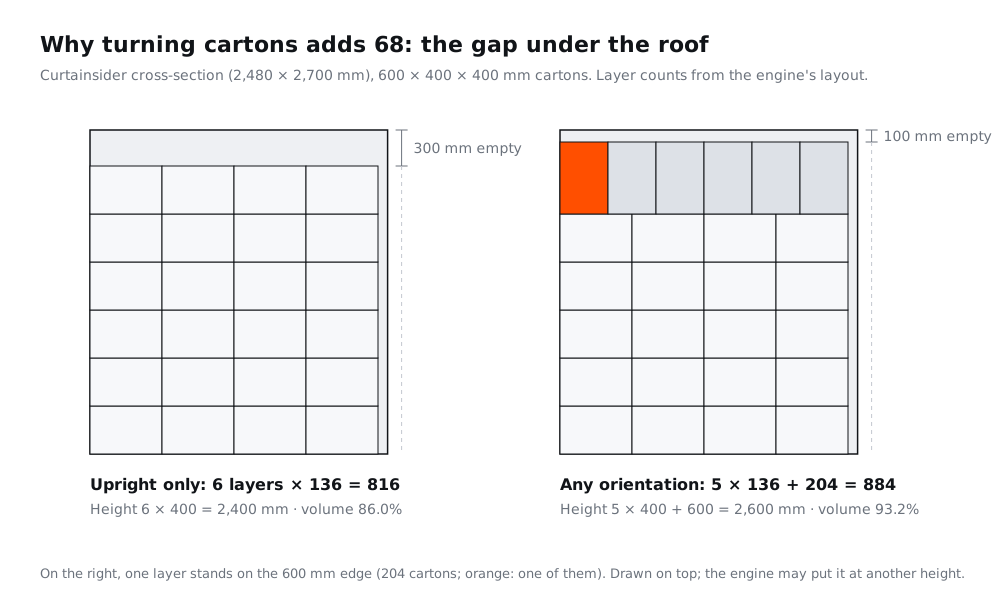
This is the cheapest gain because neither the trailer nor the packaging changes. Upright, a 600 × 400 × 400 mm carton stacks 6 high under a 2,700 mm roof: 6 × 400 = 2,400 mm, leaving 300 mm empty. In the engine's layout each layer holds 136 cartons, 816 in all.
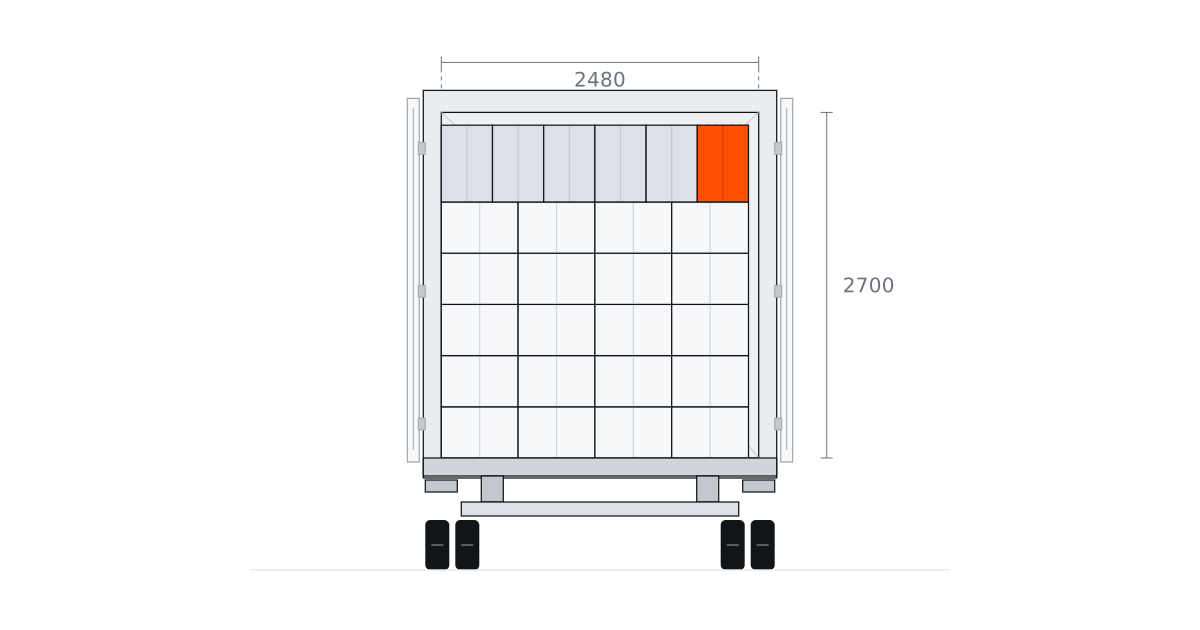
With orientation free, the engine builds one layer with the cartons standing on their 600 mm edge: 5 × 400 + 600 = 2,600 mm. Five layers of 136 plus one standing layer of 204 gives 884. The same test with a 650 × 450 × 500 mm carton goes from 565 to 613 (volume from 90.7% to 98.4%).
Turning does not help every carton. With an 800 × 600 × 450 mm carton the engine kept every carton at 450 mm high even with orientation free, because no other edge used the headroom better.
When you cannot: cartons marked "this way up" (the handling symbols in ISO 780), liquids, oils and anything that has to travel upright stay upright. If the carton's side walls were not designed to carry load, a turned carton may crush; ask your packaging supplier. In StowCargo orientation is set per line: upright, any, or fixed.
2. Match the trailer to the cargo
A mega trailer gives 300 mm more internal height on the same floor. For a 400 mm carton that is one more layer: 816 upright in a curtainsider, 952 in a mega (7 layers × 136), and 1,020 in a mega with orientation free. A 650 × 450 × 500 mm carton with free orientation goes from 613 to 681.
When it does not pay: extra height only helps if the cargo height divides into it. A 1.35 m pallet double-stacks to 68 in both a curtainsider and a mega, so the mega gains nothing. With 1.0 m pallets the mega takes a third layer, but the payload stops it at 80 pallets (lever 5). Mega trailers are not available on every lane and are priced differently, so compare quotes on the same load length.
3. Floor-load instead of palletising
Floor-loaded, 3,000 cartons (600 × 400 × 400 mm, 9.5 kg) used 4 trucks: three full at 13.6 m and the last at 9.2 m. Built onto Euro pallets the same cartons made 188 pallets and needed 6 trucks, with 7.2 m in the last. The pallet adds its own height, cartons have to fit the 1,200 × 800 mm deck, and gaps between pallets cannot be filled with loose cartons. The palletising arithmetic is in how many boxes fit on a pallet.
When you cannot: the consignee requires pallets, the receiving dock only unloads by forklift, or the freight is cross-docked on the way. Floor-loading means every carton is handled by hand at both ends, so weigh that labour against two fewer trucks.
4. Switch off stacking rules you do not need
One fragile line can stretch the whole load. The measured list: 180 glass-vase cartons (600 × 400 × 500 mm, 9 kg, no load on top), 60 ceramics cartons (800 × 600 × 400 mm, 26 kg), 260 towel cartons (600 × 400 × 400 mm, 12 kg) and 10 bathrobe pallets (1,200 × 800 × 1,400 mm, 420 kg). In total 71.52 m³ and 10,500 kg.
With space first, StowCargo's default, everything fitted in one truck at 11.4 m. With stacking rules on, the space above the vases stayed empty and a second truck was needed, carrying 4.4 m.
When you must keep the rule: if the glass really cannot take weight, a second truck is cheaper than a damage claim. The fix is to mark only the lines that truly need it: once stacking rules are chosen, every "no load on top" flag in the list is applied, and stray flags cost metres.
5. Double-stack pallets
A 1.0 m high Euro pallet (pallet included) at 300 kg fits 34 times single-stacked in a curtainsider and 68 times double-stacked. At 1.35 m it still double-stacks to 68: 2 × 1,350 = 2,700 mm, exactly the roof height. A 1.5 m pallet cannot double-stack in a curtainsider (3,000 mm > 2,700 mm) and stays at 34; a mega takes 68. Limits and checks are covered in double-stacking pallets.
When you cannot: the bottom pallet's packaging cannot carry the top one, or weight is already near the limit. A mega fits 1.0 m pallets three high, but at 300 kg each, 80 pallets reach the 24,000 kg payload; there is volume left and nothing you can do with it. How that weight lands on the axles is a separate check, see axle load calculation.
6. Pick carton sizes that suit the trailer
If you control the packaging, the carton size moves the fill rate directly. Single-size loads in a curtainsider, orientation free:
| Carton (mm) | Cartons per curtainsider | Volume utilization |
|---|---|---|
| 600 × 400 × 400 | 884 | 93.2% |
| 500 × 400 × 300 | 1,468 | 96.7% |
| 400 × 300 × 300 | 2,448 | 96.8% |
| 800 × 600 × 450 | 408 | 96.8% |
| 650 × 450 × 500 | 613 | 98.4% |
The spread is wider in containers: in a 20 ft dry container the 600 × 400 × 400 mm carton reached 81.6% and the 500 × 400 × 300 mm carton 92.2%. Container-specific numbers are in container CBM calculation.
When it does not pay: carton size follows the product and the pallet first. Changing packaging for one shipment makes no sense; this lever is for regular lanes with repeating products.
7. Do not split drops you do not need
The same four lines (260 towel cartons, 200 bedding cartons, 80 ceramics cartons and 6 bathrobe pallets, 60.38 m³) measured 9.5 m with one delivery point and 10.0 m with three. Drop order keeps lines from mixing: the last drop goes in first and each drop's cargo stays in its own zone. That order cost 0.5 m. More in multi-drop load planning.
When you cannot avoid it: real drops cost what they cost. What you can avoid is entering two orders for the same address as two separate drops.
8. Measure the last truck
A 1,377-carton list in six sizes is 110.4% of a curtainsider by volume (100.57 m³, 13,178 kg). The engine used 2 trucks: the first full at 13.6 m (96.6%), the second carrying only 2.1 m. A mega trailer (99.4% by volume) did not change the answer: still 2 vehicles, the second with 0.6 m.
From here it is a planning call: ship the 2.1 m as a part load rather than booking a full truck, hold it for the next shipment, or offer the customer an add-on order that fills the trailer. Which is cheaper depends on the lane and the delivery date; the trade-offs are in FTL vs LTL.
When you cannot: if the shipment cannot be split (one set of documents, one delivery date), you accept the gap. Knowing how many metres are free still lets you sell that space on the next order.
Try it on your own cargo
For a single carton or pallet size you can see the upright versus any-orientation difference in the free load calculator without an account. Mixed lists, stacking rules and multi-drop loads need your own packing list in the workspace; plans are on the pricing page. Whatever tool you use, write down two numbers for every plan: trucks used and load length in the last one. The percentage only means something next to them.