Mixed carton loading: how to load different size boxes
810 cartons in six sizes took 9.2 m of a 13.60 m curtainsider. Scaled up to 1,377 cartons, the list needed a second truck holding only 2.1 m. The loading order for mixed cargo and the options we measured for that 2.1 m.
· 9 min read
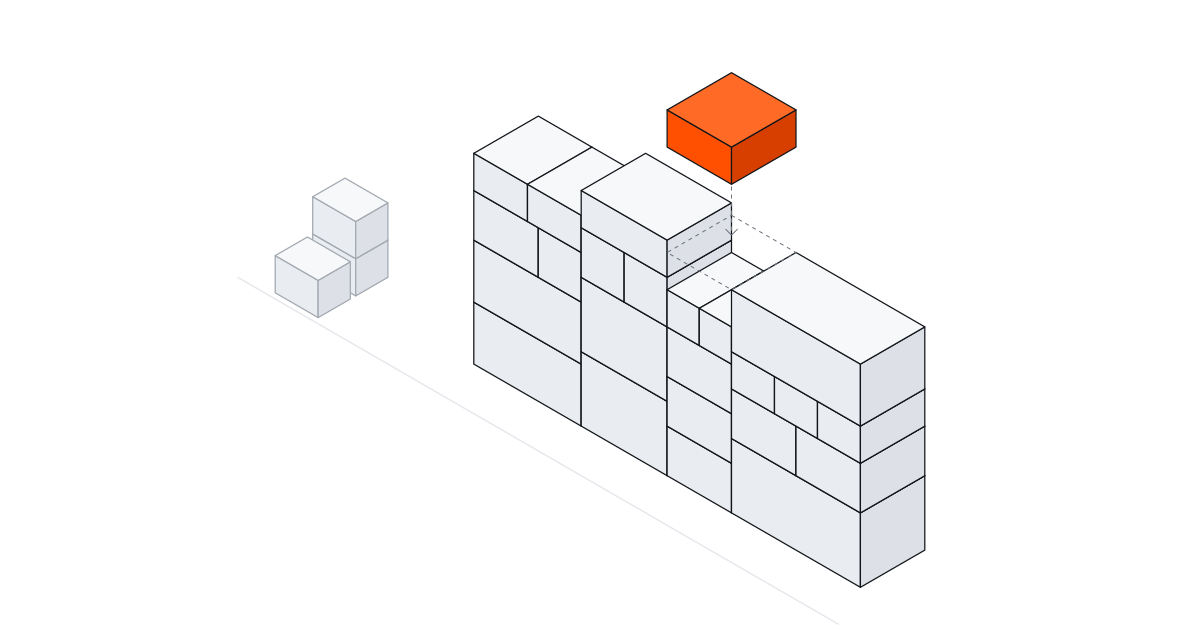
To load boxes of different sizes into a truck, start with the large and heavy cartons at the bottom, let each product build its own block from the front wall towards the doors, and keep small cartons for last so they fill the tops of blocks and the steps at the door end. Cartons from the same order stay together.
We tested this on a six-size list with the StowCargo packing engine. 810 cartons took 9.2 m of a 13.60 m curtainsider. Scaled up to 1,377 cartons, the list came to 110.4% of the trailer's volume, the engine needed two trucks, and the second one held only 2.1 m of cargo. The full input is below, so you can repeat the test with your own tools.
The loading order for mixed cargo
- Read the list as dimensions and weights. For every line: outer dimensions, gross weight, quantity, whether the carton may be laid on its side and whether it can take load on top. If the packing list doesn't say, the plan is a guess.
- Heavy and large cartons first, at the bottom. A heavy carton with a broad base makes a solid floor and keeps the centre of gravity low. Light and small cartons go on top later.
- One block per product. Cartons of the same size form full rows across the trailer. All six sizes in our list build a 2,400 mm row across the 2,480 mm width: 600 × 4, 400 × 6, 300 × 8, 200 × 12. The 80 mm left at the side wall is the same for each product.
- Fill the height by mixing products. The roof is at 2,700 mm. Six layers of 400 mm cartons reach 2,400 mm and leave 300 mm; a 300 mm bed linen carton fits that exactly. What one product leaves empty, another product can use.
- Keep small cartons for last. Blocks end at different lengths near the doors and leave steps. Small cartons go into those steps and onto the tops of blocks.
- Keep each order together and fill what's left. An order's cartons should travel in one vehicle and sit together. Load against the headboard and fill remaining gaps with dunnage; see load securing under EN 12195-1.
Measured with the StowCargo engine: six sizes, 810 cartons
We built a list similar to a typical home textiles and ceramics export order. The figures are an example chosen for the test, not a customer's shipment.
| Line | Outer size (mm) | Gross kg | Qty | Volume (m³) |
|---|---|---|---|---|
| Towel carton | 600 × 400 × 400 | 12 | 220 | 21.12 |
| Bed linen carton | 500 × 400 × 300 | 7.2 | 160 | 9.60 |
| Ceramics carton | 800 × 600 × 400 | 26 | 60 | 11.52 |
| Rug roll carton | 1200 × 300 × 300 | 18 | 40 | 4.32 |
| Small accessory carton | 300 × 200 × 200 | 3.4 | 300 | 3.60 |
| Blanket bale | 1000 × 600 × 500 | 22 | 30 | 9.00 |
| Total | 7,752 kg | 810 | 59.16 |
Method: a 13.60 m curtainsider with inside dimensions of 13,600 × 2,480 × 2,700 mm and 24,000 kg payload (the app's planning values; real trailers vary by manufacturer). App defaults: space priority, cartons upright, load against the front wall and right side wall. The engine ran with four seeds and we kept the plan with the fewest vehicles and the shortest load length.
| Run | Result |
|---|---|
| Defaults (cartons upright) | 1 truck, load length 9.2 m, 65% of volume |
| Cartons may lie on their side | 1 truck, 9.2 m |
| Stacking rules priority (an upper carton may weigh at most 6 times the one below) | 1 truck, 9.2 m |
| Small accessory cartons removed from the list | 1 truck, 8.8 m |
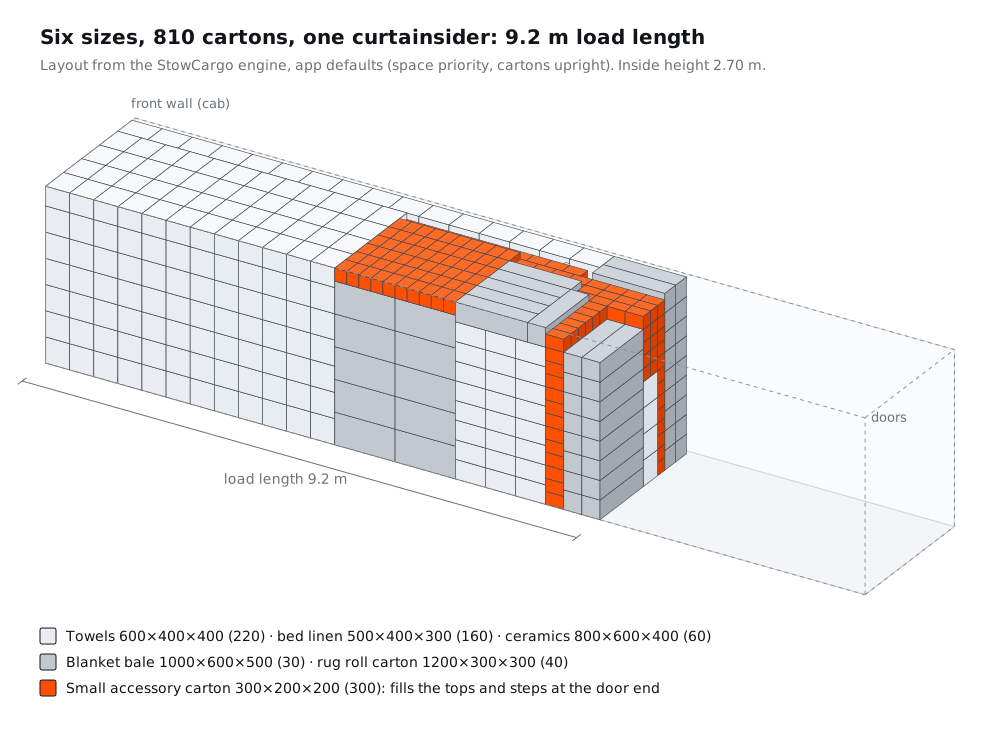
The engine's plan follows the same order. Towel, bed linen and ceramics cartons start at the front wall and advance in cross-sections; the ceramics end at 8.0 m and the bed linen at 8.3 m. The blanket bales sit between 4.8 and 6.8 m, the long rug roll cartons between 6.8 and 9.2 m, and all 300 small accessory cartons are beyond 4.8 m, on top of blocks and in the door-end steps.
You can measure what the small cartons did. Take the 300 accessory cartons out (3.6 m³, 1,020 kg) and the load shrinks from 9.2 m to 8.8 m. As a separate block across the full cross-section (2.48 × 2.70 m), the same volume would need about 0.54 m. So part of it went into gaps and part of it added length.
Why laying cartons down made no difference here
With a single carton size, orientation matters a lot. In the same series of runs, a curtainsider held 816 cartons of 600 × 400 × 400 mm upright and 884 when they could lie on their side: 68 more, or 8.3%. In a mixed list, the space one product leaves under the roof is taken by another product, so turning cartons over adds little, and the load stayed at 9.2 m. For the single-size case, see how many boxes fit on a pallet.
When the list doesn't fit: 2.1 m in the second truck
We scaled the list by 1.7 at the same proportions: 374 towel, 272 bed linen, 102 ceramics, 68 rug roll and 510 accessory cartons plus 51 bales. That's 1,377 pieces, 100.57 m³ and 13,178 kg: 110.4% of the trailer's volume, and far below its payload.
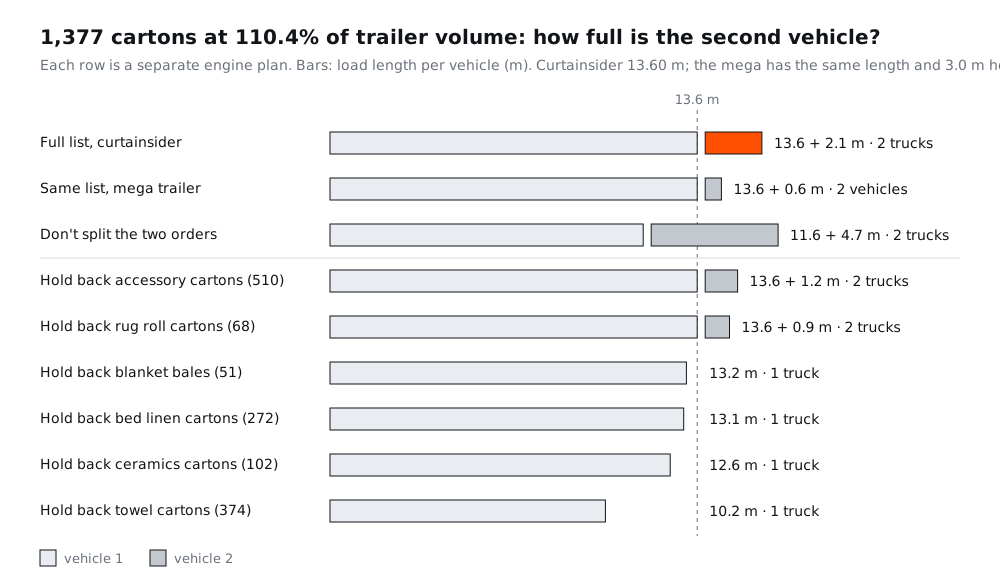
The engine planned two trucks. The first is full at 13.6 m (96.6% of volume, 10,855 kg), the second holds 2.1 m (13.8%, 2,323 kg). With free rotation it's 13.6 + 2.0 m.
The second truck is short for a plain reason: whatever doesn't fit in truck one, divided by the trailer's cross-section. The 374 cartons in truck two are about 12.6 m³; over a 6.70 m² cross-section that's 1.9 m, and the engine's plan shows 2.1 m. Most of them are small (285 accessory cartons, 48 rug roll cartons) because the engine places large cartons first, so the small ones are both last in line and the ones left over.
One warning: a list can fail to fit even below 100% of volume. The same mix at 1.5 times (88.74 m³, 97.4% of the trailer) still needed two trucks, with 71 small cartons in the second. With one line removed, at 93.6%, it fitted in one. For this mix, the one-truck limit sits somewhere between those two.
What to do with the last 2.1 m
We gave each option to the engine:
| Option | Engine result |
|---|---|
| Ship the rest separately (part load or small vehicle) | 374 cartons, 2,323 kg: 2.1 m in a trailer; fits a light truck on its own at 2.9 m |
| Mega trailer (3.0 m inside height) | Still 2 vehicles: 13.6 + 0.6 m; 45 cartons, 361 kg in the second |
| Hold back the blanket bales (51) | 1 truck, 13.2 m |
| Hold back the bed linen cartons (272) | 1 truck, 13.1 m |
| Hold back the ceramics cartons (102) | 1 truck, 12.6 m |
| Hold back the towel cartons (374) | 1 truck, 10.2 m |
| Hold back the accessory cartons (510) or the rug roll cartons (68) | Not enough: still 2 trucks |
| Don't split the two orders (towels + linen + ceramics / rolls + accessories + bales) | 2 trucks: 11.6 + 4.7 m, each order in one vehicle |
What the table tells you:
- A mega trailer doesn't save this load. Its planning volume is 101.18 m³ against 100.57 m³ of cartons, 99.4% on paper. Mixed cartons don't pack that tightly. A mega helps when the extra 300 mm of height can actually be used; see the mega trailer page.
- The line that ends up in the second truck isn't the cause. The small cartons landed in truck two, but removing them doesn't remove the truck: the 510 accessory cartons are 6.12 m³, less than the overflow. To get down to one truck you have to hold back a line bigger than the overflow.
- Keeping orders whole costs distribution here, not a vehicle. With the orders kept together it's still two trucks, but the second one carries 4.7 m instead of 2.1 m. If that truck goes to a different customer, this is the right plan.
- Sending the remainder as a part load means asking for a quote on 2.1 m of full-width cargo. How part-load rates are built from loading metres and weight is covered in loading metre (LDM) and FTL vs LTL.
Which option is cheapest depends on your freight rates and the customer's delivery date. The plan doesn't make that call; it gives you the numbers to make it.
Where this approach falls short
- Cartons that can't take load on top. Space priority ignores no-stack flags, so pick the stacking rules priority when you ship fragile goods. In our list the rules changed nothing because every carton could carry weight. In a different run where glass vase cartons could not be stacked on, space priority gave one truck at 11.4 m and stacking rules needed two (4.4 m in the second).
- Wrong dimensions. The engine works with the declared outer size. If a 400 mm carton bulges to 410 mm, a row of six becomes 2,460 mm instead of 2,400 mm and the 80 mm side margin drops to 20 mm. Measure the carton, not the product sheet.
- Heavy lists. This list never came close to 24,000 kg. With ceramics- or metal-heavy lists, weight runs out before volume and axle loads decide the plan.
- Delivery sequence. With several drops, the drop order decides where blocks go and space comes second: see multi-drop load planning.
Try it with your own list
For a single carton size, the free load calculator shows how many fit in a truck without an account. For a mixed packing list, import it from Excel into the workspace; the engine builds the plan in seconds, and if a second vehicle appears you can hold back a line and run it again to build the table above for your own list. To send the finished plan to the dock, see step-by-step warehouse loading.