Loading drums, rolls and pipes: how many drums fit?
Upright 220 L drums: 80 in a 20ft dry container, 127 in a 40ft, 114 on a curtainsider, and only the 20ft is limited by space. Lying rolls beat upright ones by 10 per trailer, and 6 m pipes skip the 20ft entirely.
· 11 min read
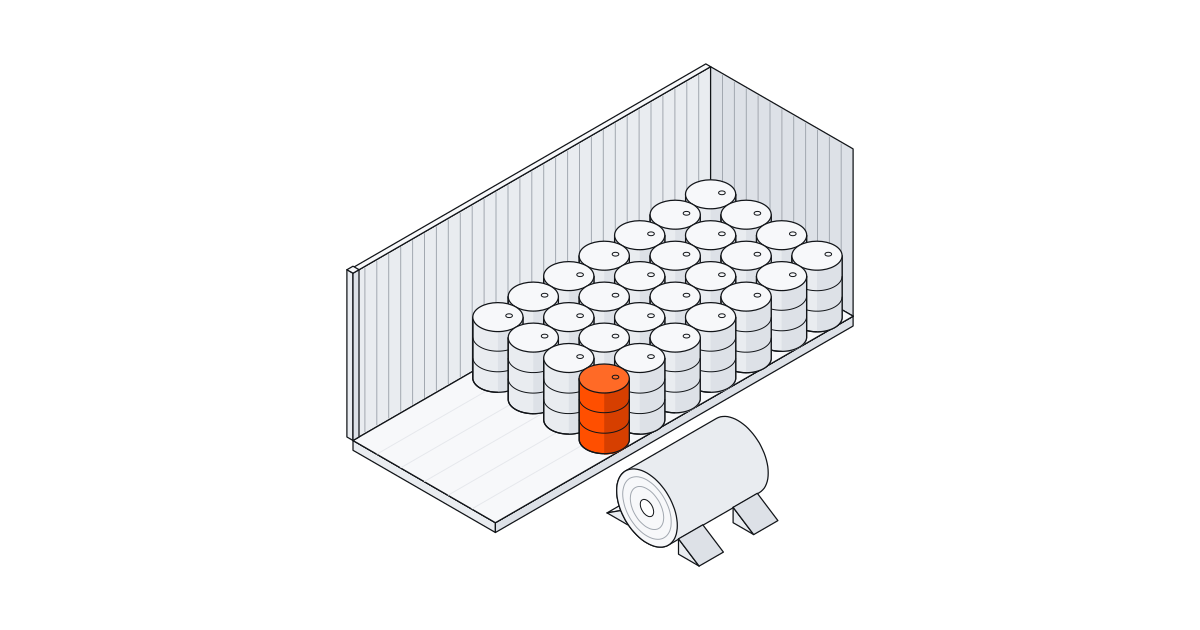
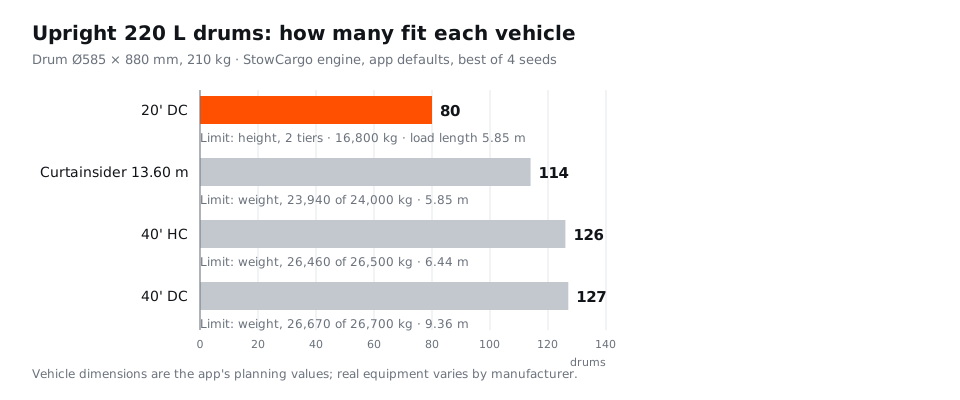
A 20ft dry container takes 80 upright 220-litre drums: 10 × 4 on the floor and a second tier on top. A third tier does not fit under the 2.39 m ceiling. Larger equipment runs out of payload before it runs out of space: with 210 kg drums, a 40ft dry container takes 127, a 40ft high cube 126 and a 13.60 m curtainsider 114.
For rolls and pipes, two decisions drive the count: whether the axis is vertical or horizontal, and the inside length of the vehicle. All counts below were measured with the StowCargo placement engine. Drum sizes vary by maker; we used Ø585 × 880 mm and a filled weight of 210 kg.
The measurements
Method: the app's default settings (space-first priority). Each item was offered as "as many as fit" for one vehicle, the engine ran with four random seeds and the run that placed the most was kept. Vehicle sizes and payloads are the app's planning values: 20ft DC 5,898 × 2,352 × 2,393 mm and 28,200 kg, 40ft DC 12,032 × 2,352 × 2,393 mm and 26,700 kg, 40ft HC 12,032 × 2,352 × 2,698 mm and 26,500 kg, curtainsider 13,600 × 2,480 × 2,700 mm and 24,000 kg. Your equipment may differ by a few centimetres and a few hundred kilos.
| Cargo | Vehicle | Axis | Fits | Limited by | Load length | Load weight |
|---|---|---|---|---|---|---|
| Drum Ø585 × 880 mm, 210 kg | 20ft DC | vertical | 80 | height (2 tiers) | 5.85 m | 16,800 kg |
| Drum | 40ft DC | vertical | 127 | payload | 9.36 m | 26,670 kg |
| Drum | 40ft HC | vertical | 126 | payload | 6.44 m | 26,460 kg |
| Drum | Curtainsider | vertical | 114 | payload | 5.85 m | 23,940 kg |
| Drum | 20ft DC | any | 106 | space | 5.85 m | 22,260 kg |
| Roll Ø1,000 × 1,500 mm, 650 kg | Curtainsider | horizontal | 36 | length and payload | 13.5 m | 23,400 kg |
| Roll | Curtainsider | vertical | 26 | height (1 tier) | 13.0 m | 16,900 kg |
| Roll | 40ft DC | horizontal | 32 | length | 12.0 m | 20,800 kg |
| Roll | 40ft DC | vertical | 24 | height (1 tier) | 12.0 m | 15,600 kg |
| Pipe 6,000 mm × Ø200 mm, 60 kg | Curtainsider | horizontal | 312 | cross-section | 12.0 m | 18,720 kg |
| Pipe | 40ft DC | horizontal | 242 | cross-section | 12.0 m | 14,520 kg |
| Pipe | 40ft HC | horizontal | 286 | cross-section | 12.0 m | 17,160 kg |
What the table says:
- With heavy drums, a 40ft does not carry twice a 20ft. In the 20ft, 80 drums weigh 16,800 kg, far below its 28,200 kg payload, because height is the limit. The 40ft DC hits its payload at 127. The ratio is about 1.6, not 2.
- Laying rolls down gains 10 rolls on a curtainsider (36 against 26).
- 6 m pipes do not fit a 20ft container. Inside length is 5,898 mm, so 6 m pipe goes in a 40ft or on a trailer.
Drums: height or payload?
Two questions decide an upright drum load: how many fit on the floor, and how many tiers. A Ø585 mm drum goes 4 across a 2,352 mm wide container (2,340 mm) and 10 deep in 5,898 mm. At 880 mm tall, two tiers need 1,760 mm and three tiers 2,640 mm. That third tier fits a curtainsider (2,700 mm) or a high cube (2,698 mm), not a standard 20ft (2,393 mm).
Room for a third tier does not make it a good idea. On a curtainsider, 114 drums occupy only 5.85 m of floor and weigh 23,940 kg. Left against the headboard, that weight goes onto the kingpin and the tractor. In the typical trailer model from our axle load calculation article, a 20 t load needs its centre of gravity at least 6.3 m behind the headboard. StowCargo shifts such a load toward the doors only as far as needed, and the gap that opens at the front then has to be blocked or filled. Spreading the drums in two tiers along the deck is the calmer fix.
In a container the same problem appears as the 60% rule: the CTU Code recommends that no more than 60% of the cargo weight sits in one half of the container's length (details in how to load a container). In a 40ft HC, 126 drums fit in 6.44 m; in a 40ft DC, 127 drums take 9.36 m. Pushed against the front wall, both put more than 60% of the weight in the front half. In StowCargo, choosing Balanced under Summary → Load position makes the rule part of the placement; in the other positions it shows as a warning on the Balance tab.
How many tiers a filled drum can carry is a packaging question, not a planning one. Ask the drum maker or the filler. A flat interlayer such as plywood or empty pallets between tiers helps the upper tier sit square.
Palletised drums: the pallet can halve the count
Four drums side by side cover a 1,170 × 1,170 mm square, so four drums do not fit an 800 mm wide Euro pallet. Squarer, wider pallets are used instead, and that is where containers bite: two 1,200 × 1,200 mm pallets side by side need 2,400 mm, and a 20ft DC is 2,352 mm wide inside.
We measured it, treating each pallet of drums as one unit: four drums plus pallet, 1,030 mm high (pallet assumed 150 mm), 865 kg (4 × 210 kg plus an assumed 25 kg pallet), stackable.
| Unit | Vehicle | Units | Drums | Load weight |
|---|---|---|---|---|
| 4 drums on a 1,200 × 1,200 mm pallet | 20ft DC | 8 | 32 | 6,920 kg |
| 4 drums, base no larger than 1,170 × 1,170 mm | 20ft DC | 20 | 80 | 17,300 kg |
| 4 drums on a 1,200 × 1,200 mm pallet | Curtainsider | 27 | 108 | 23,355 kg |
| Floor-loaded, for comparison | 20ft DC | 80 | 16,800 kg | |
| Floor-loaded, for comparison | Curtainsider | 114 | 23,940 kg |
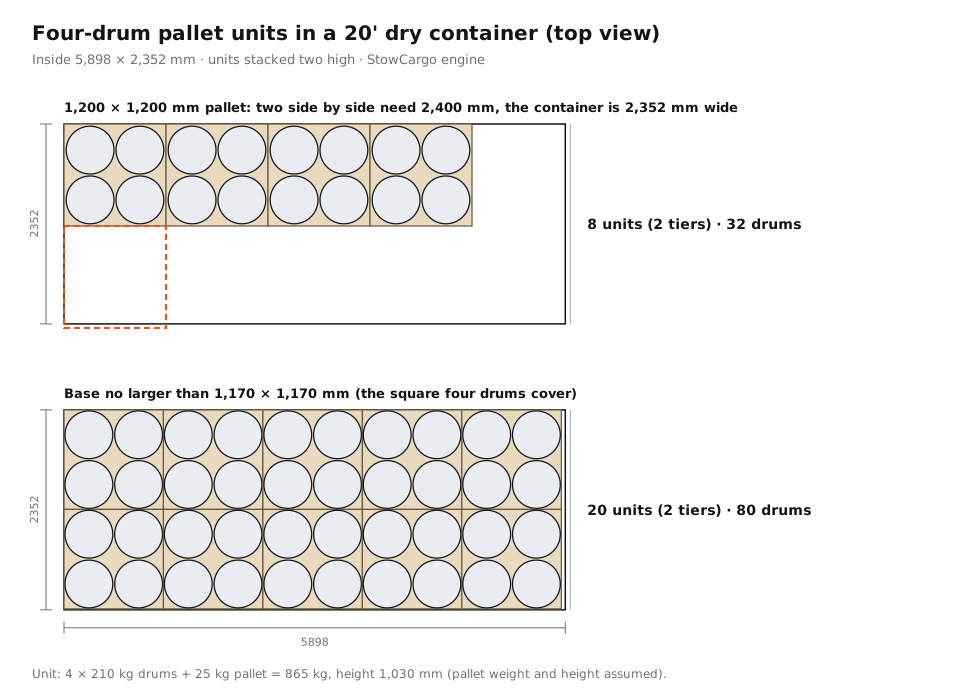
With 1,200 mm pallets the 20ft takes a single row and 80 drums become 32. If the pallet is no larger than the square the drums cover, you lose nothing against floor loading. On a curtainsider width is not the issue (2,480 mm), but the pallet tare counts against payload, so 108 drums go instead of 114. The CTU Code (Annex 7, 3.2.6) makes the same point: pallet sizes are standardised around road vehicles, not around container interiors. Choose the pallet together with the container.
To check a pallet unit like this one, the free load calculator takes a custom pallet size and weight; no account needed.
The engine stows cylinders as boxes, so reality may beat it slightly
StowCargo places a cylinder by its bounding box: a Ø585 mm drum takes a 585 × 585 mm square. The result is a straight-row pattern, which the CTU Code calls soldier stowage. Offset stowage, where each row nests into the grooves of the previous one, is not modelled.
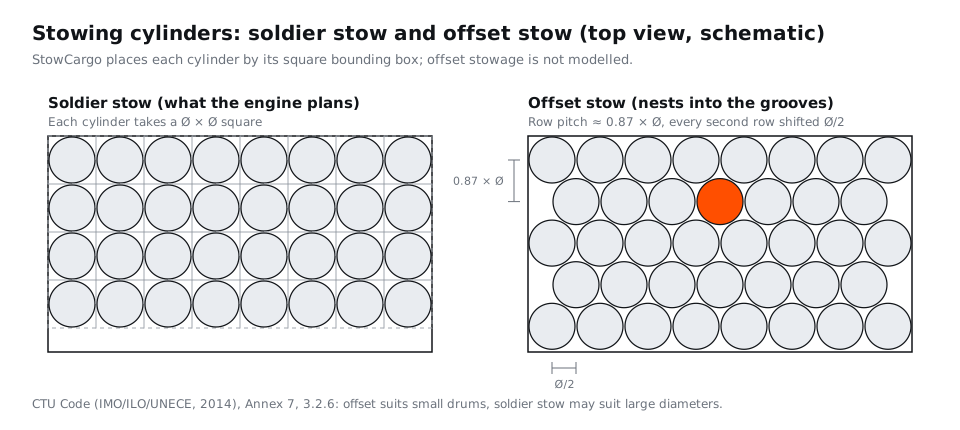
In an offset stow, row centres are about 0.87 diameters apart (√3 ÷ 2), but every second row is shifted half a diameter and may hold one cylinder less across the width. Whether you gain depends on the dimensions. The CTU Code (Annex 7, 3.2.6) notes that offset stowage tends to suit small drums and soldier stowage larger diameters, and it describes stacking pipes into the grooves of the layer below (3.2.5), with a warning: if friction between the pipes is low, the upper layers push sideways on the container walls.
So the engine's number is the count of a pattern you can actually build; if your sizes and weights are right, that many will fit. With offset stowage, pipes and small cylinders may gain a few more. Where payload is the limit, as with drums in a 40ft or on a trailer, nesting changes nothing.
Rolls: lying or upright?
A Ø1,000 × 1,500 mm, 650 kg roll goes 36 lying and 26 upright on a curtainsider. Height explains it. Upright, the roll stays in one tier (two would need 3,000 mm under a 2,700 mm roof). Lying, its 1,000 mm cross-section stacks two high: 9 rows along, 2 across, 2 high. Those 36 rolls weigh 23,400 kg, close to the 24,000 kg payload. In a 40ft DC the same roll goes 32 lying and 24 upright.
The product decides the axis, not the count. Paper, film, textile and steel rolls each come with the maker's handling rules; plan to those. Watch the wording on the instruction too. The Container Handbook (4.2.4.1) notes that "upright" and "on its side" are understood differently from region to region and lead to errors. Writing "axis vertical" or "axis horizontal, along the vehicle" on the plan avoids the argument.
Securing changes with the axis. The German insurers' transport information service TIS (GDV) suggests: horizontal rolls can go in several layers, with the bottom layer held by wedges and plastic mats between layers to raise friction; vertical rolls are stowed tight, dead space is filled, and the door end is held with nets or beams. The wedges need securing as well. The CTU Code (Annex 7, 2.3.5) says to nail them to dunnage placed under the cargo and notes that the wooden floors of closed containers are generally not suitable for nailing. For lashing forces, see load securing to EN 12195-1.
Pipes: length picks the vehicle
A curtainsider takes 312 pipes of 6,000 mm × Ø200 mm at 60 kg: 2 along (12 m), 12 across and 13 high. The remaining 1.6 m can take shorter items. A 40ft DC takes 242 and a 40ft HC 286; the only difference is height (11 against 13 layers). A 20ft takes none.
Weight is rarely the issue with pipe (312 pipes weigh 18,720 kg); rolling is. Hold the bottom layer with wedges at the sides; the CTU Code singles out nailed-on wedges as useful for round shapes like pipes. Enter bundled pipe in the plan as a box with the bundle's outer size, and loose pipe as cylinders.
Dangerous goods drums have their own rules
CTU Code 10.3.6: drums containing dangerous goods should always be stowed upright unless the competent authority allows otherwise. That is why the "any" row in the table (106 drums in a 20ft DC) is for non-dangerous cargo only: the engine lays some drums on their side there, and a lying drum rolls unless it is chocked. TIS also recommends metal drums upright, tight, with the bungs on top.
Segregation, labelling and documents for dangerous goods come from ADR on the road and the IMDG Code at sea, and are outside this article. Settle them with your carrier and your dangerous goods safety adviser before loading.
Entering cylinders in a plan
In StowCargo, open the item details and set Shape: Cylinder; length is the axis, width is the diameter. Position has three options: Upright (axis vertical), Lying (axis horizontal, along or across) and Any (the engine decides). Units such as palletised drums go in as boxes with the pallet base and overall height. Space-first priority ignores no-stack flags but keeps the position you set. Import the packing list into the workspace and drums, cartons and pallets are placed in one plan.
Inside dimensions are on the 20ft dry container, 40ft high cube and 13.60 m curtainsider pages. With cylinders, the mistakes we see most are a short, heavy load left against the front wall and lying cylinders loaded without chocks; the other usual suspects are in export loading mistakes.